
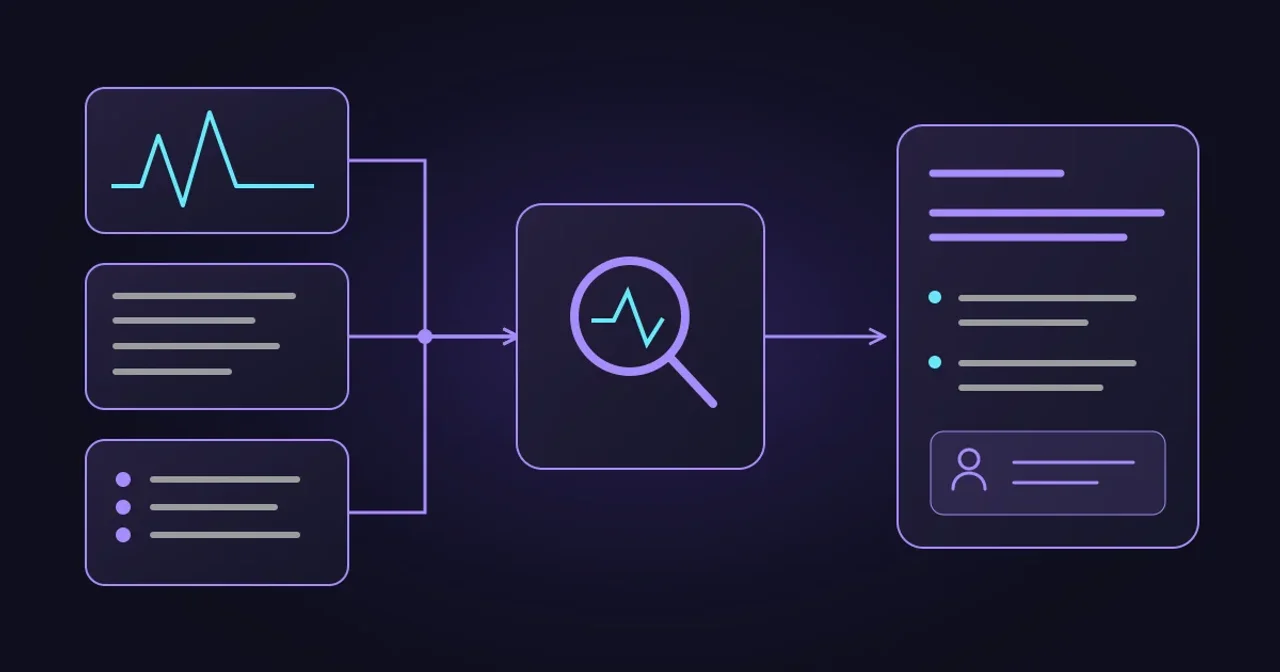
AI agents for broadcast incident investigation
AI agents for broadcast incident investigation could help with a familiar control-room problem: the alarm is clear, but the explanation is scattered across several systems. A channel’s output looks healthy while viewers on one delivery path report stalled playback. Someone must establish the scope, compare evidence and decide which check comes next.
Our introduction to agentic AI in broadcast operations sets out where adaptive investigation can be useful. Here, we examine the evidence an operator needs before authorising a recovery action. The workflow below is a proposed architecture, not a description of deployed Evrideo agent functionality.
Give AI agents for broadcast incident investigation usable evidence
Keep dependable alarms and established recovery procedures. Google’s SRE guidance distinguishes externally observed symptoms from internal diagnostic signals and warns against assuming monitoring can establish causality automatically. An agent should work within that discipline. Google SRE: Monitoring Distributed Systems.
A script can join records and execute a branching runbook. An agent may help when the next enquiry depends on an unfamiliar combination of results: selecting another diagnostic tool, interpreting an operational note or revising an explanation when a comparison contradicts it. That flexibility needs testing against the existing process.
Connect identifiers and times
Give the investigation a channel, rendition, destination and observation window. Map the identifiers used by playout, packaging, delivery and player reporting. OpenTelemetry supports correlation through time, execution context and resource context; it does not create your broadcast service map automatically. Some infrastructure logs lack trace context. OpenTelemetry logging specification.
Record event time and collection time separately. UTC formatting does not prove clocks are synchronised. Keep known clock uncertainty visible, and use a trusted probe’s elapsed time for repeated measurements where practical. Otherwise, an apparent sequence of failures can simply reflect delayed telemetry.
Include the viewer’s symptoms
Successful requests at the origin tell you little about whether a particular player is progressing. Common Media Client Data (CMCD) defines structured player information, including buffer length and buffer-starvation signals, that can accompany delivery requests or reach collection endpoints. Available fields depend on implementation and what the player knows. CTA WAVE: Common Media Client Data.
Use player evidence alongside delivery probes. Record the affected device group, territory and reporting coverage where available. Missing player data should remain an explicit gap.
Investigate a stale live playlist
Consider a hypothetical conventional HLS channel. A deterministic alarm reports a possibly stale media playlist at one CDN location. Other locations appear healthy. The agent has read-only access to approved diagnostic tools and redacted operational records.
Compare the same delivery path
Collect repeated snapshots of the same logical playlist at the origin, affected location A and comparison location B. Confirm the rendition, serving location and any personalisation that could select different content. Record fetch times, playlist contents and whether newly listed segments can be retrieved.
Inspect the latest available segment, not just EXT-X-MEDIA-SEQUENCE. That tag identifies the first listed segment, so an append-only playlist can progress without changing it. Equal sequence numbers in different playlists do not establish matching content. Use the matching timeline and segment durations when assessing lag. RFC 8216: HTTP Live Streaming.
Sample over a period appropriate to the stream’s publication cadence. One unchanged response is weak evidence. If the origin and B keep advancing while A repeatedly returns older content, the investigation can focus on A’s delivery path.
Try to disprove the first explanation
The agent should request evidence that distinguishes possible causes. Check whether A reaches the expected origin, whether an intermediate cache differs, and whether another authorised probe reproduces the symptom. Review relevant configuration changes without treating their timing as proof of causation.
If the origin also stops advancing, investigate packaging or shared upstream dependencies. If the playlist advances but segments fail, inspect segment delivery. If the second probe works, examine routing, request differences and the original measurement before recommending a cache change.
This is where an agent could earn its place: choosing the next useful question and updating its explanation across incomplete evidence. Known checks and timing calculations should remain deterministic tools. An unresolved investigation should end with a clear evidence gap and escalation owner.
Hand the operator a decision they can review
Prepare a compact incident report with links to source observations:
- Scope: Channel, rendition, confirmed delivery location, observation window and affected player group.
- Evidence: Origin/A/B comparison, segment retrieval results, player symptoms and clock uncertainty.
- Assessment: Leading explanation, strongest alternative, contradictory findings and missing records.
- Proposed action: Exact runbook step or next diagnostic check, expected effect, responsible operator and rollback conditions.
- Recovery test: What must improve, where it will be measured and how long the observation should continue.
Avoid a percentage confidence score unless it has been calibrated against representative incidents. Operators need to see why the recommendation follows from the evidence. Remove access tokens and personal identifiers from material passed to the model.
Cache purges, routing changes and service restarts require separately enforced permissions and approval. Treat logs, playlist comments and retrieved documents as untrusted evidence: an instruction embedded in them must never grant authority. OWASP recommends limiting agent functionality and privileges, enforcing authorisation downstream and requiring approval for consequential actions. OWASP: Excessive Agency.
Prove that the investigation helps
After an approved intervention, repeat the same comparisons. Look for sustained playlist progression, retrievable new segments and resolution of the observed player symptoms. Check the unaffected location for regressions. When only probes are available, report probe recovery rather than claiming every viewer has recovered.
Before production use, replay historical incidents with misleading changes, delayed logs and multiple faults. Compare the agent’s reports with the team’s existing tools and runbooks. Measure evidence accuracy, unsupported conclusions, operator corrections, query cost and appropriate escalation when evidence is insufficient.
Record alert time, evidence-ready time, approval time and sustained recovery separately. A quicker report is useful only if it supports a sound decision; it does not establish a reduction in total recovery time.
Choose one recurring incident class for an initial pilot of AI agents for broadcast incident investigation. Evrideo’s Broadcast platform provides the channel-operations foundation; any proposed agent integration needs its own access controls and acceptance tests. Talk to Evrideo about the investigations that consume your team’s time and the evidence needed to assess a pilot.
Related Articles
AI Scheduling for Linear TV and FAST: The Metadata You Need
September 23, 2026 · 6 min read
AI Agents for Content Ingest: From Delivery to Ready for Air
September 23, 2026 · 6 min read
Agentic AI in Broadcast Operations: Where Should You Start?
September 10, 2026 · 6 min read