Receive the source you have
Bring SRT, UDP, SDI, MPEG-TS files and live HLS/DASH sources into your distribution workflow. Connect broadcast infrastructure with internet-delivered streams.

Bring SRT, UDP, SDI, transport-stream files and live HLS/DASH sources into one routing workflow. Prepare codecs, audio and MPEG-TS signalling for each destination, with monitoring, recording and backup routes in the same browser interface.
An SRT gateway receives contribution feeds and routes them to the systems that need them. Outpost also connects SDI and UDP infrastructure with HTTP streaming sources and outputs, so operators can manage the handoff in one place.
Bring SRT, UDP, SDI, MPEG-TS files and live HLS/DASH sources into your distribution workflow. Connect broadcast infrastructure with internet-delivered streams.
Prepare video, audio and stream signalling for each destination. Share transcoding across outputs that need the same version to make better use of your server capacity.
Follow input analysis, SRT statistics, stream states and event history. Configure a backup stream and a looping backup file for each supported output route.
A walkthrough of the Evrideo Outpost platform — remote ingest, signal monitoring, and multi-site broadcast management.
Evrideo Outpost — SRT gateway walkthrough
Deploy Outpost where it makes sense for your business — on-premise, in your private cloud, or fully managed by Evrideo.
Receive, process and distribute live video with controls that operators can inspect and test.
Bring live HTTP streams into your broadcast workflow. Choose the rendition you need, manage buffering and reconnect automatically when a source becomes available again.
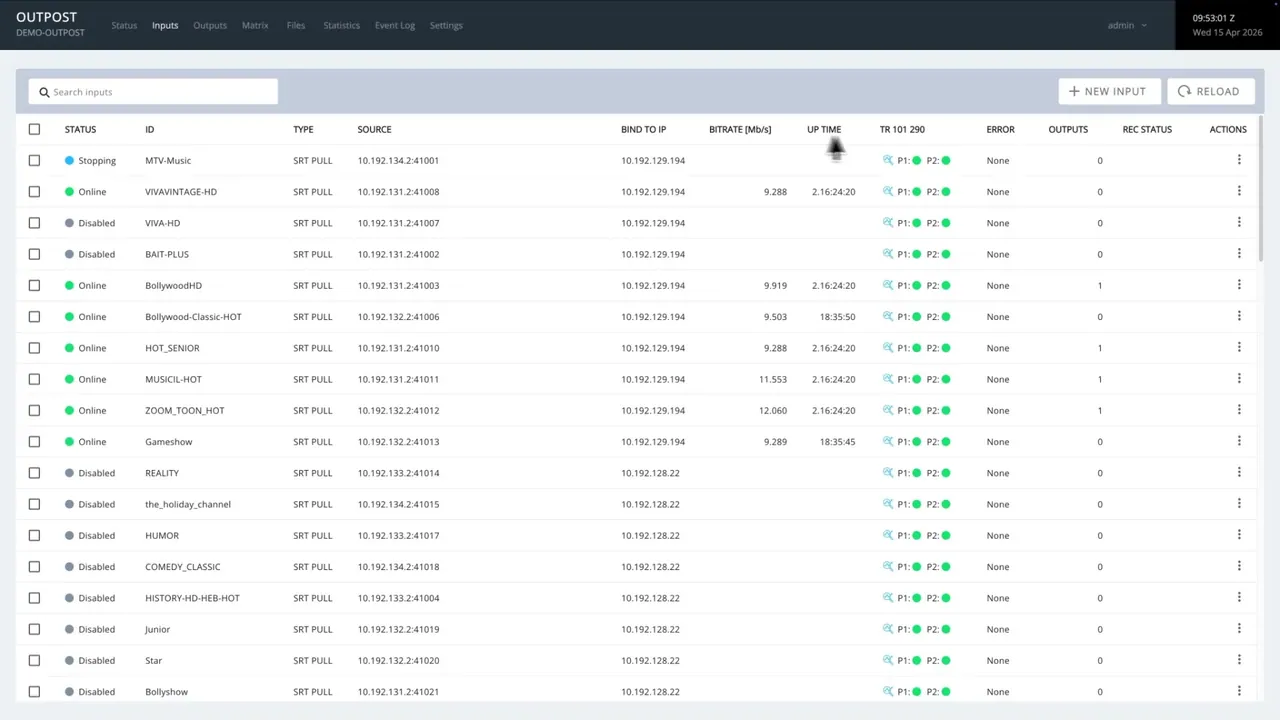
Identify input issues with ETSI TR 101 290 priority 1 and 2 analysis, transport statistics and SRT diagnostics. Give operators the information they need to investigate a problem.
Prepare backup feeds and looping standby content for input outages. Configure switching and recovery to suit the needs of each delivery route.
Record inputs on demand or on a schedule. Reuse MPEG-TS recordings for replay, testing or standby content.
Create delayed SRT, UDP, HLS and DASH outputs for regional schedules and repeat services, with delays from 30 minutes to 48 hours.
Monitor up to 12 streams in a thumbnail grid, save views for your team and connect your operations tools through the REST API and JSON event relay.
Solve the awkward handoffs between contribution, distribution and downstream partner requirements without adding another proprietary appliance.
Receive one SRT source and replicate it to multiple destinations without deploying another proprietary hardware appliance for every route.
Prepare the codec, bitrate, transport layout and SCTE signalling each syndication partner requires before handoff.
Connect SRT, UDP, SDI and adaptive streaming workflows across public internet, private infrastructure and cloud environments.
Connect your sources, prepare each feed and deliver it in the formats your partners need.
Use CPU-based encoding on standard servers. Our team can help size your deployment around the channels, renditions and destinations you need.
Select the video, audio and signalling each destination needs. Reuse shared processing across outputs to keep distribution manageable as you add partners.
Select elementary streams from one or more inputs and set their output programs, PIDs and language descriptors. Combine a picture from one source with audio from another.
Encode H.264 or HEVC video and AAC or AC-3 audio, then share the same processed stream across multiple outputs.
Create video renditions for HLS and DASH delivery so your distribution workflow can serve different streaming requirements.
Translate SCTE-104 messages in SDI ancillary data to SCTE-35 on capture, and translate SCTE-35 back to SCTE-104 for SDI delivery.
Choose audio PIDs, channel layouts and sample rates. Add PNG or JPEG logos when processing video, and use SDI output for DVB subtitle burn-in.
Carry transport-stream ad cues into HLS and DASH outputs, helping downstream systems identify advertising opportunities.
Everything you need to know. Can't find the answer you're looking for? Contact our team.
An SRT gateway receives SRT video feeds and routes them to other destinations. Outpost adds software transcoding, stream monitoring, recording, backup routes and connections to UDP, SDI, HLS and DASH workflows.
Yes. Outpost receives live HLS and MPEG-DASH sources and converts a selected rendition to MPEG-TS, connecting HTTP streaming sources with your broadcast distribution workflow.
Yes. Route one input to multiple destinations and share stream processing across outputs. Prepare the video, audio, branding and signalling each partner needs from one browser interface.
Outpost provides configurable backup streams and looping standby files. Your team can define switching and recovery behaviour around the needs of each route.
Outpost combines SRT diagnostics, transport-stream input analysis, stream previews and event history. Saved matrix views and API integrations help your team investigate issues and coordinate operations.
Yes. Deploy Outpost on your Linux infrastructure or choose a fully managed Evrideo SaaS service. Our team can help plan the capacity and interfaces for your channels and delivery destinations.
Transform your contribution and distribution workflows with broadcast-grade reliability and IT simplicity.
Tell us about your business and which tier interests you. Our team will be in touch within two business days.
Contact us