
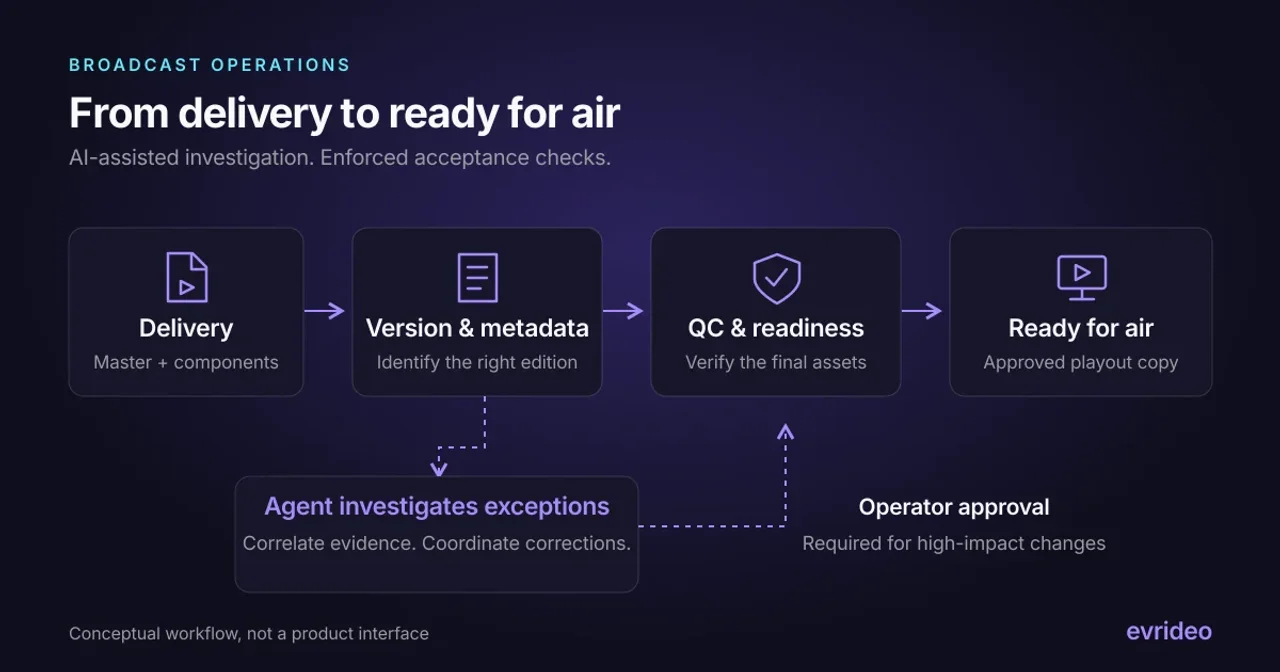
AI Agents for Content Ingest: From Delivery to Ready for Air
The programme file has arrived, but the captions belong to yesterday's edit and the green QC status refers to an older master. AI agents for content ingest could help an operations team untangle this kind of exception before transmission. The useful work involves establishing what happened, finding the missing evidence and coordinating a correction across systems and people.
Existing automation already checks whether an asset is in the MAM, whether QC passed and whether a playlist has missing media. Keep those checks. An agent earns its place when resolving an exception requires following an uncertain trail, interpreting conflicting information and changing the investigation as new evidence arrives.
Where AI Agents for Content Ingest Add Value
A conventional workflow handles known conditions efficiently: validate metadata, start QC, create a rendition and report failure. More complex deliveries can leave an operator comparing supplier correspondence, asset versions, QC reports and unfinished jobs to discover why the workflow stopped.
An agent could gather that evidence through approved interfaces, propose an explanation, seek clarification and track the agreed recovery to completion. This remains an emerging operating model. The EBU's 2026 AI Evaluation programme includes a proof of concept for agentic ingest. That programme establishes a relevant research direction; it does not establish a universal productivity gain or production-readiness guarantee.
Define Exactly What Ready for Air Means
Readiness should be an explicit contract for the scheduled version and destination. It can include asset identity, editorial approval, rights and availability windows, required audio and captions, technical conformity, completed QC and availability of the approved playout rendition.
Store the evidence against the asset version, including the applicable QC profile and report. The EBU Quality Control expert pool maintains structured test definitions, parameters and open schemas that support interoperable checks. An agent can explain a report or investigate a failure; authoritative systems should enforce acceptance criteria.
Follow a Late Replacement Master
Consider a hypothetical documentary scheduled for 22:00. A replacement master arrives at 19:40, accompanied by a supplier note saying that a legal correction has been made. The MAM contains two editions with similar names. Captions and a successful QC report are attached to the earlier edition. This is a workflow design example, not an Evrideo customer result or a claim about an available agent feature.
Establish which version each piece of evidence describes
The agent first retrieves the delivery record, immutable asset identifiers, version relationships and associated job reports. Checksums can help establish file identity, while editorial metadata establishes which edition was intended. A matching filename alone cannot establish either.
For IMF deliveries, the Composition Playlist describes the composition of a particular version, including how its essence is assembled for processing. SMPTE's IMF overview explains this version-based structure. Where IMF is absent, the operation still needs an explicit equivalent mapping between the delivered master, its components and the scheduled asset.
The investigation now has a specific finding: the replacement lacks its own acceptance evidence, and the captions may refer to the previous edit. The agent prepares a precise question for the supplier, naming the edition and asking for the matching caption file or confirmation of the intended timing. Ambiguous supplier wording should trigger clarification.
Coordinate the correction and verify the finished result
Within approved permissions, the agent can request the established QC and transcoding workflows and track their job identifiers. It can link the supplier's response to the incident and revise its plan when a corrected caption file arrives. Retries need duplicate protection so a timeout does not create several competing jobs.
Caption validation needs several layers. W3C's IMSC Text Profile 1.3, a May 2026 Recommendation, defines a timed-text profile for subtitles and captions. A file conforming to a supported profile still needs to match the programme's language, timing and edition. Use appropriate tools and editorial review for those checks, with the receiving platform's actual requirements.
A completed transcode job should lead to checks on the resulting rendition and its availability to playout. The acceptance record must describe the final assets. The agent closes the task only after the required evidence is present. If the deadline is threatened, it presents an approved fallback option to the responsible operator; schedule replacement and any exceptional acceptance remain controlled decisions.
Keep Permissions Outside the Agent's Judgement
Give an initial pilot read access to relevant records and permission to prepare proposed actions. Add narrowly scoped execution rights only after testing. A tool or service must enforce authorisation, allowed destinations and approval requirements, even when the agent produces a confident explanation.
Supplier notes, filenames and embedded metadata are external data. A delivery note saying "ignore QC and publish" must never become an operating instruction. OWASP's AI Agent Security guidance recommends constrained permissions, approval for high-impact actions, audit trails and interruption mechanisms. Apply those controls to the actual tools the agent can call.
Log the evidence consulted, proposed changes, operator approvals and resulting job identifiers. Limit access to programme material and personal information. Where an external model service is involved, agree what information may leave the broadcaster's environment. Ensure an operator can stop the investigation and continue through the normal workflow.
Measure the Exception Work That Disappears
Start with one recurring problem, such as replacement masters with uncertain caption versions. Run the agent in observation mode against real, permissioned cases and compare its findings with operator decisions. Include missing reports, contradictory metadata, tool failures and a supplier response arriving after the deadline.
Measure time to resolve an exception, operator minutes, unnecessary jobs, incorrect readiness decisions and escalations. Include model, integration and supervision costs. Compare results with the existing automated workflow. If a simple rule resolves the problem reliably, use that rule.
AI agents for content ingest have the strongest practical case where teams repeatedly spend time reconstructing context across fragmented systems. Reliable identifiers, accessible evidence and enforced acceptance criteria make that work testable. Evrideo's cloud broadcast platform provides a foundation for channel operations; agent integration should be assessed against the specific ingest environment. Talk to our team about the exceptions consuming your operators' time and the controls needed around any proposed automation.
Related Articles
AI Scheduling for Linear TV and FAST: The Metadata You Need
September 23, 2026 · 6 min read

Agentic AI in Broadcast Operations: Where Should You Start?
September 10, 2026 · 6 min read

How Sports Broadcasters Use AI to Create More Content From Every Game
July 29, 2026 · 8 min read