
AI Scheduling for Linear TV and FAST: The Metadata You Need
A library of 5,000 programmes gives a scheduler plenty of choice. It still cannot tell the scheduler which episode may legally run at 20:00, whether it fits, or whether viewers have seen it three times this week. AI scheduling for linear TV and FAST depends on making those distinctions explicit.
FAST is itself linear television: viewers join a scheduled stream. The useful comparison is between traditional broadcast or cable programming and internet-delivered FAST channels. Both need editorial identity, audience flow and reliable timing. Their distribution arrangements, economics and available audience data can differ considerably.
Traditional Scheduling Strategies Still Matter
Programmers have long used placement to encourage viewing habits and audience retention. Research into audience-flow scheduling examined lead-ins, lead-outs, hammocking and blocks decades before generative AI. Those strategies provide useful starting points, with results to test on each channel.
| Strategy | Traditional application | Application to FAST |
|---|---|---|
| Stripping | The same series occupies a consistent daily slot. | Preserve daily appointments or build a single-series channel with deliberate episode rotation. |
| Rotational wheel | Several series take turns in the same recurring slot. | Rotate franchises within a recognisable strand, balancing variety with familiarity. |
| Blocks and stacking | Group compatible programmes or consecutive episodes. | Build themed sessions, marathons and story arcs while controlling repetition. |
| Hammocking | Place a less-established programme between two strong performers. | Test discovery and retention across the transitions, where reporting permits. |
| Tent-poling | Use a major programme to anchor the surrounding schedule. | Support a premiere, live event or promoted library title with relevant lead-ins and follow-ups. |
| Counter-programming | Offer an alternative to competing programmes. | Target an underserved viewing occasion while keeping the channel’s identity clear. |
| Dayparting | Match programming to viewing occasions across the day. | Plan for the feed’s actual regions and time zones, rather than assuming one global evening. |
Stunts and crossovers create special occasions; crossover episodes need explicit viewing order. Bridging crosses familiar start-time boundaries to encourage continued viewing, but requires accurate guide information and compatible platform rules.
A rotational series wheel also differs from a programme clock, which describes the arrangement of content, breaks, promotions and continuity within a repeatable time period. Define which meaning your scheduling system uses.
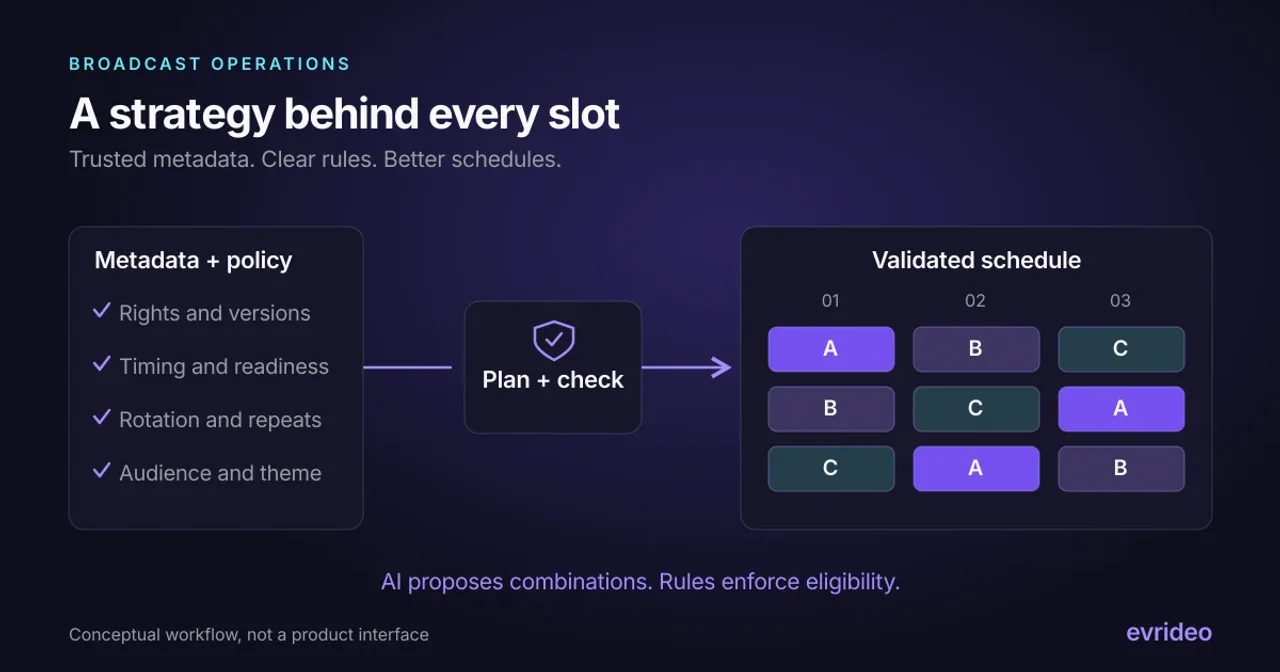
For example, a Sunday 20:00 mystery strand could rotate Series A, B and C over three weeks, advancing each series to its next eligible episode when its turn returns.
What Changes with FAST?
A niche channel can favour a consistent genre or franchise over a broad evening lineup. Library depth and repeat spacing become important: endlessly replaying the strongest title can exhaust its appeal. Streaming reports can inform experiments, but data access, latency and granularity vary by distributor. A programme’s apparent success may also reflect prominent placement in the platform’s guide.
SSAI is a separate advertising function. Google’s DAI documentation describes ad stitching into live and linear streams. It does not make programme schedules personalised. A shared channel can carry different ads for different viewers; schedule changes still need rights clearance, valid timings and coordinated EPG updates.
AI Scheduling for Linear TV and FAST: Required Metadata
Treat the following as an operational checklist, not a universal schema. EBUCore offers a shared metadata model, while SMPTE BXF supports exchanging schedules, content metadata, as-run information and related workflow messages. Neither replaces your scheduling policy.
Authoritative data that determines eligibility
| Metadata group | Information the scheduler needs |
|---|---|
| Identity and version | Stable programme, series, season, episode and asset IDs; approved edition; relationships between master, captions and playout rendition. |
| Rights | Permitted territories, platforms, channel/feed, business model, languages, start/end windows, run limits and contractual exclusions. |
| Timing | Exact playable duration in frames or rational time units; frame rate; segment boundaries; credit/intro handling; live-event and overrun rules. |
| Readiness | QC result tied to the version; editorial clearance; delivery/transcode status; required audio, captions and accessible renditions. |
| Suitability | Applicable classification, content advisories, approved audience/daypart restrictions and review status. |
| Commercial structure | Approved break positions and durations, cue availability, sponsorship obligations, inventory ownership and separation rules. |
| Scheduling history | Actual and planned airings, repeat gaps, remaining runs, series order and crossover dependencies across relevant feeds. |
| Guide and distribution | Localised titles, descriptions, artwork and identifiers; publication deadlines; timezone; schedule revision and delivery status. |
Missing rights or unverified suitability should make an asset ineligible for autonomous publication. Rights systems supply permissions; an AI-generated synopsis cannot establish them. Gracenote’s schedule documentation illustrates why event times, identifiers, updates and platform-specific usage rights must remain connected.
Record the source, revision date and owner of authoritative fields. Recheck rights across the entire airing and asset readiness before publication.
Descriptive data that improves selection
Genre, subgenre, themes, mood, pace, cast, setting, seasonality and whether an episode stands alone help rank eligible choices. AI can propose these tags from transcripts or media analysis. Record their source, confidence, review status and taxonomy version. Keep inferred labels distinct from verified facts.
Performance data should retain its platform, region, time window, sample size and metric definition. A session is not necessarily a person. Raw views alone cannot establish that one programme caused better retention.
Turn Editorial Intent into Enforceable Rules
Metadata describes content. A scheduling policy describes the channel: wheel membership and cycle position, fixed appointments, dayparts, episode order, repeat separation, commercial clocks and optimisation goals.
Separate hard constraints, such as rights and exact timing, from preferences, such as thematic continuity or predicted viewing. Store local programming rules with an explicit timezone and resolve daylight-saving changes. Agree a publication freeze window so a late optimisation does not invalidate the advertised guide.
Where AI Adds Value
Rules engines and optimisation solvers can already construct valid schedules. AI can enrich discovery metadata, interpret a programmer’s brief, propose thematic combinations and investigate why a requested schedule is impossible. A deterministic validator should check every proposed playlist before publication.
Consider a hypothetical 60-minute FAST hour containing two 22-minute programmes, 12 minutes of agreed advertising inventory and four minutes of promotions and continuity. The clock balances exactly. The ad allocation is illustrative, not a recommended limit.
If the preferred episode’s rights have expired, the system filters it out. An agent could find an approved alternative with similar subject matter and duration, explain its weaker audience evidence and preserve episode order. If no eligible combination fits, it must use a pre-approved fallback or escalate, rather than inventing permission or silently trimming content.
Decide When a Person Must Intervene
Begin with human approval of proposed schedules. Allow automatic publication later for tested content pools and bounded policies, with monitored outcomes. Keep editorial policy changes, disputed rights, sensitive content and unplanned live disruptions subject to explicit escalation.
Enforce permissions in the publishing service, record decisions and approvals, and retain a last-known-good schedule. OWASP’s agent-security guidance supports limited privileges, approval controls and interruption mechanisms. Treat supplier descriptions as data, never instructions to override policy.
AI scheduling for linear TV and FAST becomes practical when reliable metadata, clear editorial strategy and enforceable constraints work together. Evrideo’s cloud broadcast platform provides the channel-operations foundation. Discuss your scheduling workflow with our team to identify what can run automatically and which decisions still deserve an experienced programmer.
Related Articles
AI Agents for Content Ingest: From Delivery to Ready for Air
September 23, 2026 · 6 min read

Agentic AI in Broadcast Operations: Where Should You Start?
September 10, 2026 · 6 min read

How Sports Broadcasters Use AI to Create More Content From Every Game
July 29, 2026 · 8 min read