
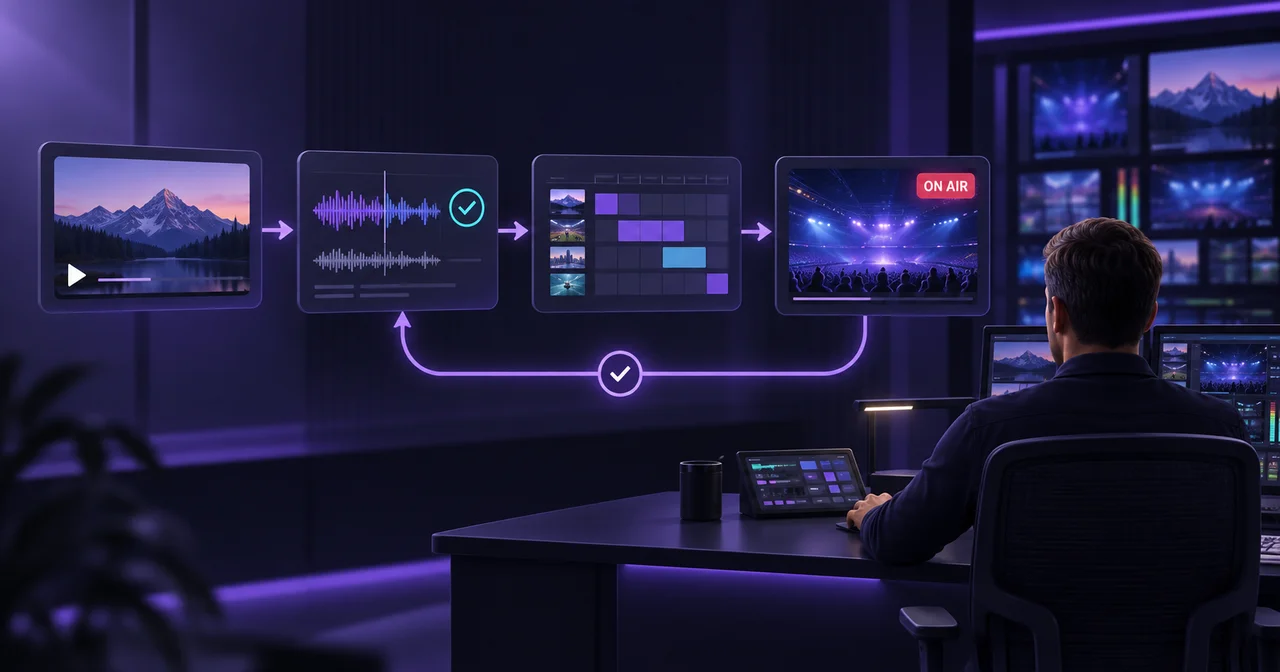
Agentic AI in Broadcast Operations: Where Should You Start?
Your playlist already knows whether an asset exists and has passed QC. What should an AI agent add? Agentic AI in broadcast operations deserves a place where an experienced operator still has to investigate unfamiliar problems, interpret incomplete information and coordinate a response across systems. Repeating checks that the platform already handles reliably adds little value.
Evrideo already checks playlists against MAM assets and their QC status without AI. Keep that automation. A more useful starting point is the investigation that follows an exception: deciding what else to examine, testing possible explanations and adapting the response when new evidence changes the picture.
The EBU's AI Evaluation group includes agentic AI and ingest proof-of-concept work in its 2026 focus. This signals industry exploration; it provides no assurance of production reliability or savings (EBU AI Evaluation).
Choosing a First Use Case for Agentic AI in Broadcast Operations
Rules-based systems can handle complex workflows, dependencies and recovery actions. Complexity alone is a poor reason to introduce an agent. The stronger case involves variable investigations whose next useful step depends on information discovered along the way.
An agent can select diagnostic tools, examine their results, consult relevant documentation and revise its plan. Anthropic's original engineering guidance describes this dynamic approach while recommending simpler solutions wherever sufficient. This is vendor guidance, with explicit trade-offs in cost, latency and error risk (Anthropic, Building Effective Agents).
A dashboard summary needs language generation. A predefined sequence of API calls needs workflow automation. An agent becomes useful when it must work out which enquiries and actions will advance a goal, then check whether they actually helped.
Choose a bounded investigation
For a first pilot, try: "Investigate playback failures reported by Partner A and propose a recovery plan with supporting evidence." Limit the channels, systems and time window it can inspect. Keep frame-accurate switching, QC decisions and protection mechanisms in their established control systems.
A Practical Example: One Partner Has Lost Playback
Imagine a distribution partner reports black screens while the channel's output monitor looks healthy. The following investigation is illustrative, rather than a description of a deployed Evrideo agent.
- Establish the scope. The agent compares affected sessions, destinations and incident times. Other partners are playing normally, so it prioritises Partner A's delivery path while keeping a shared upstream fault open as a possibility.
- Follow the evidence. Manifest and segment requests succeed, but the affected player's DRM licence requests fail. That result redirects the investigation towards licence delivery and authorisation. A successful HTTP response alone would not prove that media was decodable.
- Test a hypothesis. The agent retrieves approved integration notes, redacted request logs and recent configuration changes. It finds a licence-endpoint change near the incident's start. Through an authorised test-player tool, it requests a controlled comparison against the known-good configuration. Timing alone is insufficient evidence of causation.
- Adapt the plan. If that comparison restores playback, the agent proposes a partner-scoped configuration correction, with evidence, affected services and a rollback procedure. If it fails, the agent continues investigating other explanations instead of repeating the same fix.
- Verify recovery. An operator reviews the proposed change. After an approved deployment through existing controls, fresh playback tests and partner confirmation establish whether service has recovered. Unresolved failures remain open.
The diagnostic path changes with the evidence. Another incident might lead towards an expired token, stale manifest or incompatible rendition. Building and maintaining every possible investigation branch can become expensive; an agent offers a way to handle some of that variation. Repeated, well-understood fixes should still become conventional automation.
Other operational candidates
A live sports overrun could require revised schedules, advertising commitments and partner notifications. An agent could interpret producer updates, request feasible options from scheduling tools and revise its proposal as the expected finish changes. Timing calculations and rights constraints should remain enforced by authoritative systems, with editorial and commercial decisions approved by the responsible people.
Partner onboarding is another candidate: interpret a delivery specification, identify missing information, prepare a configuration for review and investigate failed acceptance tests. These are proposed applications requiring validation, not promises of current Evrideo agent functionality.
Set Permissions Before Connecting Tools
Start with read-only investigation and isolated diagnostic tests. Restrict tools, channels and data access through actual permissions. Keep credentials and decryption keys outside the model's context. Treat partner documents and logs as evidence, never as instructions granting new authority.
OWASP recommends limited functionality and privileges, approval for consequential actions, and authorisation enforced downstream. Apply those protections before allowing an agent to change production configuration (OWASP, Excessive Agency). Record tool calls, evidence and approvals, and provide a stop mechanism.
Run Alongside the Team Before Delegating Work
Replay historical incidents in a test environment, including cases with misleading clues, missing logs and multiple simultaneous faults. Compare the agent with the existing tools and operator process. Measure time to a verified diagnosis, operator effort, incorrect conclusions, unsafe proposed actions and recovery success. Include supervision and API costs.
The NIST AI Risk Management Framework Playbook offers voluntary guidance organised around Govern, Map, Measure and Manage. It can help structure this evaluation; it does not certify an agent's operational safety (NIST AI RMF Playbook).
Build Confidence One Workflow at a Time
Agentic AI in broadcast operations should earn its place by resolving work that still demands sustained investigation and coordination. Start with one recurring class of incident, a named owner and measurable outcomes. Expand only when the evidence supports it.
Evrideo Broadcast already brings scheduling, content management and playout together. Build on that foundation when considering agent integrations. Talk to our team about the operational investigations that consume your engineers' time and whether a controlled pilot could help.
Related Articles
How Sports Broadcasters Use AI to Create More Content From Every Game
July 29, 2026 · 8 min read
AI Scheduling for Linear TV and FAST: The Metadata You Need
September 23, 2026 · 6 min read

Live sports overruns: coordinating changes with AI agents
October 7, 2026 · 6 min read