How Sports Broadcasters Use AI to Create More Content From Every Game
Every live game contains far more publishable content than most sports teams and broadcasters can release. Goals, saves, turning points, tactical patterns, player stories and crowd reactions all compete for the same small post-production team. By the time an editor has found the moment, cut it, reframed it, captioned it and entered metadata, the audience may already have moved on.
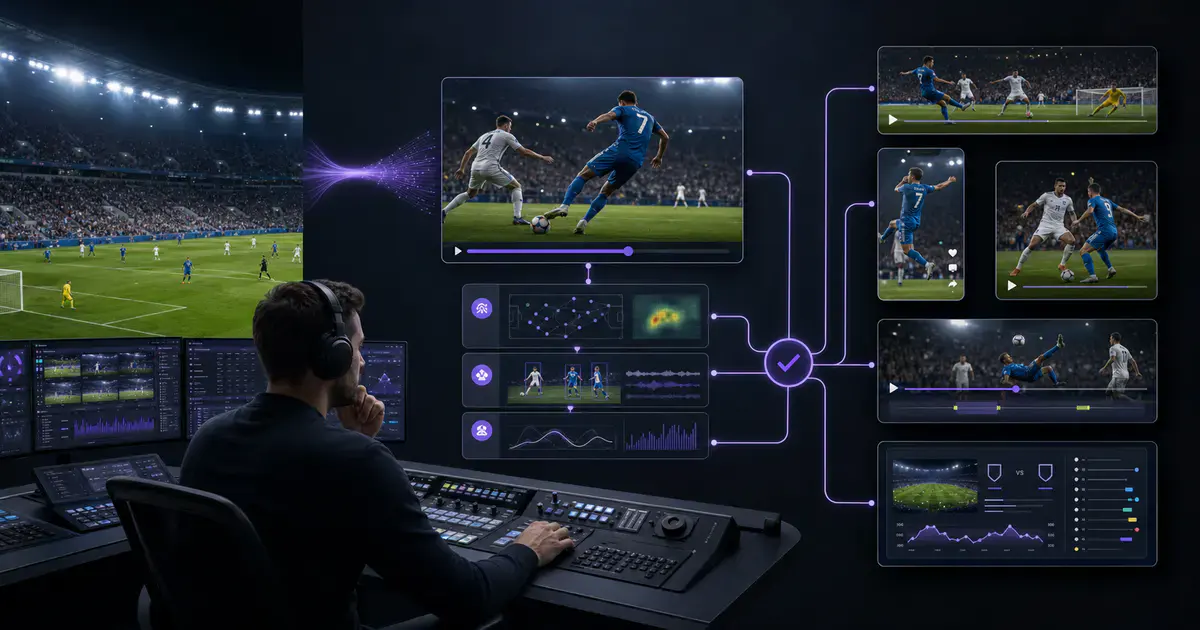
AI sports content workflows can narrow that gap. They combine event data, video and audio analysis, speech recognition and workflow automation to identify candidate moments, prepare multiple versions and route them to an editor. The objective is not to replace editorial judgement. It is to remove repetitive searching and formatting so people can concentrate on context, rights, quality and storytelling.
AI Sports Content Starts With Events, Not Editing
The most reliable workflow begins with signals that describe what happened. Depending on the sport, those signals may include the official data feed, scoreboard changes, commentary, crowd response, object tracking, camera cuts or operator markers. A scoring event is high confidence when several signals agree; a subtle defensive sequence may still require a producer to recognise its significance.
Cloud demonstrations already show how these inputs can work together. AWS has published a near-real-time motor-racing architecture that combines live telemetry, machine learning and generative AI to create detailed summaries and highlight candidates. Its 2025 automated-highlights demonstration also shows the same source being adapted automatically for widescreen, square and portrait destinations (AWS AI-generated race summaries and highlights; AWS automated highlights demonstration).
Detect first, then build a useful editing package
A detected event should not be treated as a finished clip. It should create an editing package: source timecode, pre-roll and post-roll, event type, participants, score context, confidence level, rights information and links to alternate camera angles. The system can then propose a clean in-and-out point while preserving enough context for an editor to extend or reject it.
This distinction matters. A goal is rarely just the ball crossing the line. The build-up may explain the skill, the replay may reveal the decision, and the celebration may be the moment fans share. Automation should make those elements faster to assemble, not flatten every sport into the same six-second template.
One Approved Moment Can Become a Content Family
Once an editor approves a moment, a workflow can produce several deliverables from the same editorial decision:
- Broadcast replay: a clean widescreen clip with frame-accurate timing and house graphics.
- Vertical social video: a 9:16 crop that follows the action and keeps captions inside safe areas.
- Square or landscape posts: platform-specific versions with the correct duration, slate and thumbnail.
- Accessible versions: transcripts, captions and translated text prepared for review.
- Searchable archive: structured metadata that connects the clip to teams, players, competition, score and rights window.
The value compounds because metadata created for publishing also improves discovery later. Producers can search for every late winner by a player, every power-play goal in a season or every interview mentioning an opponent without manually logging the archive again.
Near real time is an operational design problem
ABEMA provides a useful production example. In an AWS case study, CyberAgent describes using AI and machine-learning services to detect football goals, create highlight videos and draft social copy. The stated goal is to reduce the work required per editor and publish more real-time highlights, with expansion planned to other sports (AWS and CyberAgent ABEMA case study).
The lesson is that model accuracy alone does not determine speed. The media must arrive with usable timecode, proxy creation must keep pace with the live feed, rendering capacity must be available, and approvals must reach the right person immediately. A brilliant detector connected to a slow manual handoff still produces late clips.
Keep Humans at the Editorial and Rights Boundary
Sports content carries risks that an event classifier cannot resolve alone. A clip may contain an injured athlete, an disputed officiating decision, restricted music, a sponsor conflict or footage that is licensed for broadcast but not social media. Player names and generated summaries can be wrong. A technically correct highlight can also be editorially misleading when it omits the score or sequence that gave the moment meaning.
Human review should therefore be proportional to risk. Low-risk internal logging can be fully automated. Public social posts may require a rapid producer approval. Sensitive incidents, youth sport, gambling-related material and rights-restricted competitions need stricter checks. Each output should retain provenance: source asset, model or rule version, edit history, approver and publication destination.
The All England Lawn Tennis Club and IBM offer a useful adjacent example of governed AI. Wimbledon’s 2025 Match Chat and live win-likelihood features combine match data and generative AI inside an official fan experience rather than presenting an unverified general-purpose output (IBM and Wimbledon 2025 announcement). The IOC’s AI agenda likewise frames adoption around a human-centred approach, a useful principle for any rights holder deploying automation at scale (IOC Olympic AI Agenda).
Design the Workflow Around Audience Demand
More clips only create value when they reach audiences in the right form. Ofcom reports that 94% of UK 15–24-year-olds use social media each month, while its 2025 Media Nations analysis says YouTube viewing on television sets continues to grow (Ofcom Media Nations 2025). Sports publishers therefore need both rapid mobile-native clips and richer highlights that can travel to connected-TV and on-demand environments.
Start with a narrow operational target rather than an ambition to “use AI”. A good first workflow might detect scoring events, create a horizontal and vertical candidate, attach official metadata and place both in an approval queue within 60 seconds. Measure detection precision, time to approval, percentage published, correction rate, audience engagement and cost per usable clip. Expand only when the workflow is reliably creating content the team would otherwise have produced.
Conclusion: Turn Every Game Into a Reusable Content Supply
AI sports content creation is most valuable when it connects live signals, editorial review, format adaptation and publishing as one controlled workflow. It can help a small team cover more matches, release more versions and build a richer archive, but speed should not come at the expense of rights, accuracy or context.
Evrideo RapidClip helps broadcast and sports teams move from live and long-form sources to publishable short-form content, while Evrideo’s cloud platform keeps contribution, playout and distribution connected to the same operational environment. The result is a faster path from the moment on the field to the audience that wants to see it.