
Live sports overruns: coordinating changes with AI agents
A match goes into extra time. The next programme has already been promoted, a sponsor expects its booked placement, and a distribution partner still shows the original finish. Live sports overruns turn one changing fact into several operational decisions, each with a different owner and deadline.
An AI agent could help gather those dependencies, investigate missing information and keep a proposed response current. The strongest opportunity is the coordination work between systems and people. Timing calculations, playlist validation and frame-accurate execution belong in the established broadcast tools.
The EBU’s AI Evaluation group identifies agentic AI as a 2026 focus, including practical proof-of-concept work. That supports evaluating bounded applications; it doesn’t establish that autonomous sports-overrun handling is production-proven. The workflow below is a proposed operating model, not a claim about a deployed Evrideo agent.
Build a shared picture of live sports overruns
Start with the event identifier, affected feeds, current schedule revision and the latest producer estimate, including its source and timestamp. An estimated finish remains uncertain until production confirms the handback. A score feed or language model shouldn’t decide that transmission has ended.
Give the agent access to schedule constraints, rights records, commercial bookings, approved programme versions and partner update procedures. Each source needs an owner. A missing contractual condition should become an explicit question for the responsible team, never an inferred permission.
Separate fixed commitments from available choices: a hard junction, a rights-window end, a movable repeat, a shortened edition and optional continuity material. Ask the scheduling engine to calculate feasible variants. Existing deterministic automation can do this arithmetic and reject impossible schedules without AI.
Work through a changing finish time
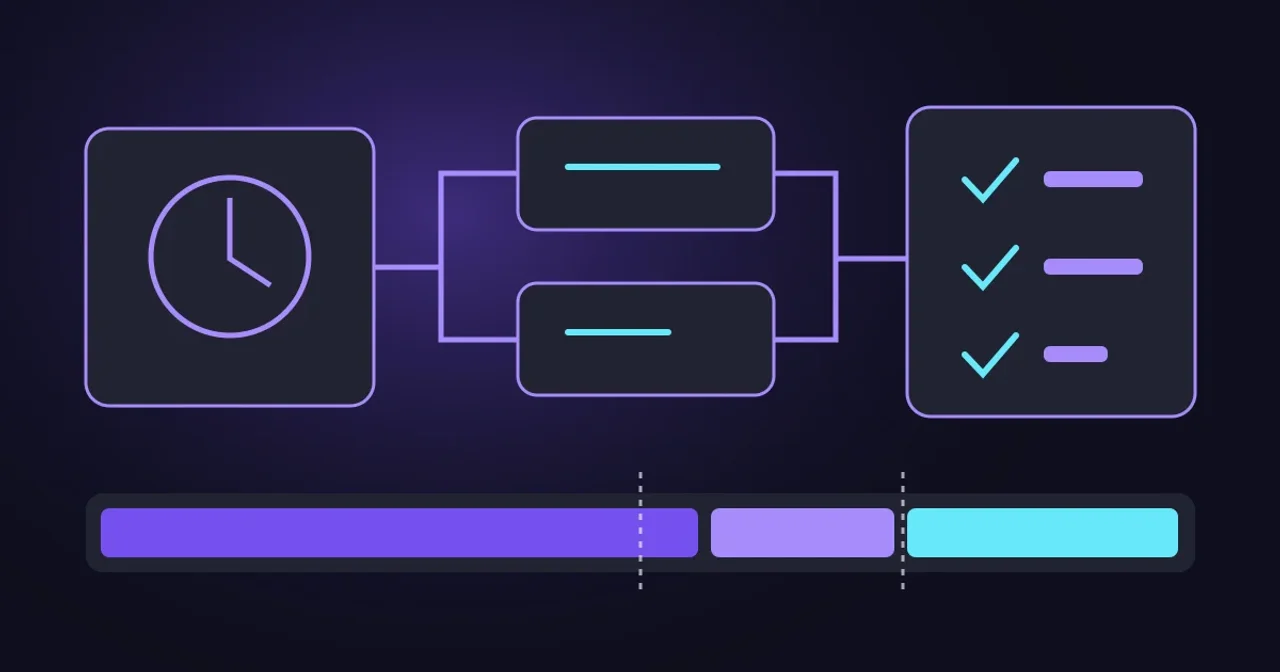
Consider this hypothetical rehearsal. Live coverage should hand back at 21:00. A 30-minute magazine follows, then a fixed 21:30 junction. Production now estimates 21:12. All times use the channel’s declared timezone, and the durations include the scheduled junction material.
An approved 18-minute magazine edition would fit the remaining window. The agent locates its asset identifier, then asks existing systems to confirm readiness, captions, rights and timing. It also checks whether the shortened edition retains a booked sponsor placement. A filename containing “short” proves none of those conditions.
Investigate the exception that changes the plan
The commercial record says the sponsor placement belongs to the full edition. The agent asks the authorised commercial owner whether the shorter edition is acceptable and prepares the timing consequences of each response. It can draft the question with the relevant booking and programme identifiers rather than sending a vague request to everyone.
Production then revises the estimate to 21:18. Only 12 minutes remain, so the 18-minute option is withdrawn. The scheduling engine can evaluate an approved 12-minute replacement or another permitted route; the agent explains the newly affected obligations and obtains the missing decisions. If no valid plan remains, it escalates to the transmission lead.
This changing investigation is where an agent may earn its cost: it chooses the next enquiry from the evidence, follows up an unresolved dependency and revises its proposal. Compare it with the existing runbook and automation before deciding that an agent is useful.
Could Jev shorten the decision loop?
TypeSafe’s Jev returns predefined choices and scores, with probabilities, and evaluates questions in parallel. It could classify producer messages or route an ambiguous partner reply for review. An LLM could handle longer investigations and draft the operator briefing.
TypeSafe reports 70-500 ms responses, with evaluations generally run near its US West Coast service. These are vendor results, not broadcast benchmarks. Compare accuracy and end-to-end latency against a small, low-latency LLM on your own messages. Faster inference leaves API waits and approvals unchanged. Jev can select a wrong answer within a valid schema; retain operator approval and deterministic playout controls. Repeated triage across many feeds is a sensible pilot.
Approve an exact revision
Show the operator a concise change record: affected services, old and proposed schedule, displaced items, commercial exceptions, required partner updates and unresolved questions. Name who approved each exception and when the approval expires.
Tie permission to that specific revision. Recheck the current playlist immediately before applying it, because another operator may have edited it during the discussion. For APIs that support them, conditional requests such as HTTP If-Match help prevent overwriting a changed resource. Other integrations need an equivalent version check. A changed finish estimate requires a fresh assessment.
Coordinate the destinations separately
An updated playlist leaves several downstream tasks:
- Advertising: have traffic and commercial teams resolve displaced spots, sponsorship and any required make-goods. Verify approved break changes through the existing signalling workflow.
- Programme guides: update the electronic programme guide (EPG), including the affected following programmes, and track each destination’s acceptance and refresh behaviour.
- Graphics and continuity: replace stale coming-next messages, check language variants and confirm the correct material is ready for transmission.
- Distribution: confirm feed-specific rights, permitted fallback content, partner deadlines and any destination that cannot follow the revised schedule.
For DVB services, ETSI EN 300 468 V1.19.1 distinguishes present/following event information from scheduled event information; its Event Information Table carries start time, duration and running status. Check both the current event and the future listing where supported. Streaming platforms have their own interfaces and refresh rules, so a successful guide export doesn’t prove every viewer sees the correction.
Keep one record per destination: requested revision, submission time, acknowledgement and observed result. Report unavailable confirmation honestly. If a partner cannot update before the junction, give the operator that fact while there’s still time to choose a response.
Keep execution controlled when time is short
Start the pilot with read access and draft proposals. Require explicit approval for on-air changes and commercial concessions. OWASP’s AI Agent Security guidance recommends scoped tools, independent authorisation and approvals bound to exact actions. Enforce these controls in the execution service, outside the model.
Producer messages, partner emails and retrieved documents are evidence. Embedded instructions must never expand permissions. Limit recipients and data exposure, log tool outcomes, and provide an operator stop control. Use duplicate protection for writes and reconcile ambiguous timeouts before retrying.
Agree a decision deadline before rehearsal. When it expires, the named transmission lead follows the established contingency plan. Stopping the agent must leave the channel’s normal control systems usable. Reverting an unexecuted schedule change is possible; already aired material requires a forward recovery decision.
Rehearse the handback and measure the work
Include a second overrun, a late rights clarification, a conflicting operator edit and a partner that acknowledges an update but displays stale information. Verify the actual handback, following programme, graphics and destination guide, then reconcile the as-run record with advertising obligations.
Measure time to an approved feasible plan, operator effort, rejected unsafe proposals, stale approvals and unconfirmed destinations. Include supervision and integration costs. NIST’s AI RMF Playbook offers voluntary guidance for governing and evaluating these risks; the team still needs its own acceptance criteria.
Choose one recurring class of live sports overruns for a controlled pilot. Evrideo Broadcast brings scheduling and playout together; assess any agent integration against your actual permissions and partner workflows. Talk to our team about the coordination work that delays your decisions when the match runs late.
Related Articles
AI agents for broadcast incident investigation
September 30, 2026 · 6 min read
AI Scheduling for Linear TV and FAST: The Metadata You Need
September 23, 2026 · 6 min read
AI Agents for Content Ingest: From Delivery to Ready for Air
September 23, 2026 · 6 min read