
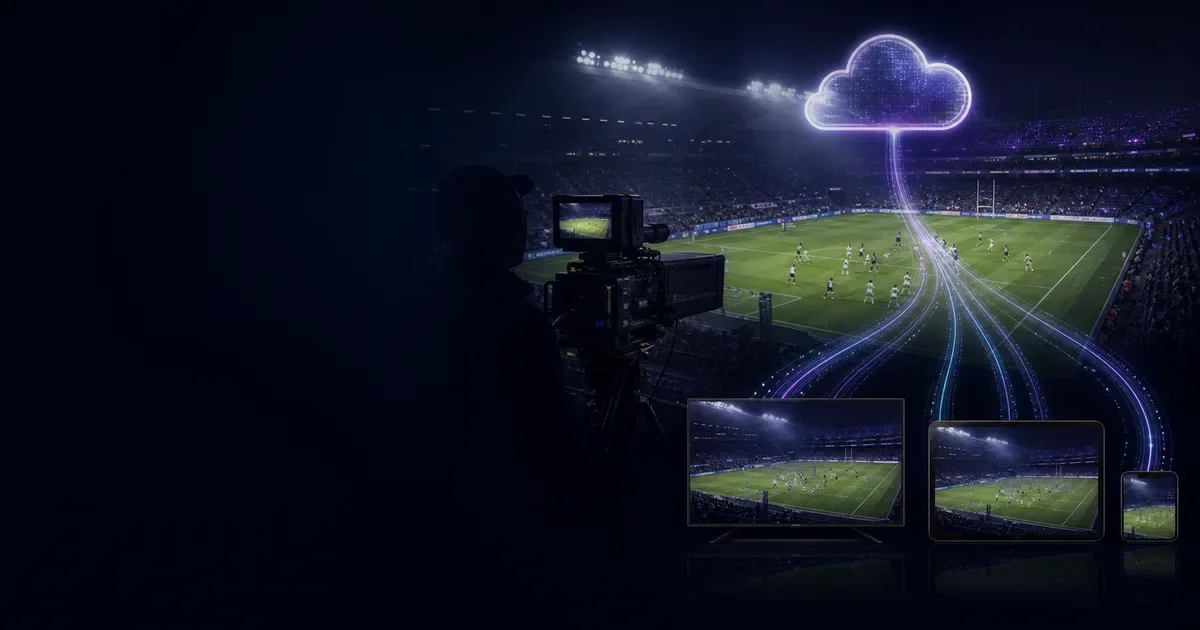
Why Sports Rights Holders Are Launching Their Own Channels
In 2025, Major League Baseball said 27 of its 30 clubs had a direct-to-consumer streaming option, with 14 clubs adding one during a single offseason. That is a useful signal of a wider change: sports rights holders are no longer satisfied with being content suppliers alone. Leagues, federations, teams and event owners are increasingly operating branded channels of their own.
The goal is not necessarily to replace broadcasters or sell every match directly. An owned channel gives the rights holder a permanent media product that can combine live events, archive programming, highlights, interviews and sponsor content. It creates a direct audience relationship while preserving the option to license premium rights territory by territory.
Why Sports Rights Holders Are Launching Channels Now
They need a direct relationship with fans
A traditional rights deal delivers reach and a predictable fee, but the broadcaster normally controls the customer account, viewing data and product experience. An owned service gives the rights holder first-party information about registration, location, favourite teams, viewing frequency and content preference, subject to the appropriate consent and privacy controls.
That insight can improve scheduling, sponsorship and membership offers. It also shows where an audience exists before the next rights negotiation. Deloitte’s 2025 sports outlook argues that digital distribution enables direct fan access and that stronger fan-data programmes can support new partnerships and revenue streams (Deloitte 2025 Global Sports Industry Outlook).
One event can support an always-on media business
Premium live rights are only one part of a sports archive. Full replays, condensed games, documentaries, press conferences, youth competitions, classic moments and shoulder programming can keep fans engaged between fixtures. Packaging that library as a scheduled channel gives the audience something to watch without asking them to search for an individual video.
The NFL Channel is a clear example. The league describes it as a free, 24/7 service carrying game replays, original programmes and live game-day coverage. It is available in the NFL app and across connected-TV partners including Roku, Samsung TV Plus, Tubi and others (NFL Channel). The channel does not carry live NFL games, which shows how an owned service can create value around premium rights rather than undermine them.
Distribution no longer has to mean one destination
An owned channel can appear in the rights holder’s app, on a FAST platform, inside an established streaming service and through regional media partners. FIFA’s 2026 FIFA+ arrangement illustrates that hybrid model. FIFA says the service on DAZN will include around 8,500 live matches annually from roughly 100 member associations, alongside archive and original programming, while using DAZN’s distribution reach and audience tools (FIFA+ on DAZN).
Ownership therefore means control of the brand, content strategy and audience proposition. It does not require owning every consumer app or delivery network.
Three Channel Models for a Sports Rights Holder
Premium direct-to-consumer
A subscription service works where the rights holder controls valuable live inventory and can offer a clear package. MLB’s 2025 model combined club-specific streaming products with continued distribution through satellite, cable and streaming providers. MLB said its five directly produced club services removed local blackouts and included enhanced production features such as additional camera positions and interviews (MLB’s 2025 distribution announcement).
Free ad-supported or FAST
A free channel lowers the barrier to discovery and can monetise archive, highlights and secondary competitions through advertising and sponsorship. It is often a better starting point for niche sports, federations with geographically dispersed audiences, or rights holders whose first objective is reach rather than subscription revenue.
A hybrid service
Many strong propositions combine a free channel, premium live access and licensed distribution. NBA League Pass, for example, offers live and on-demand games, alternate feeds, mobile views and multiple languages, while its availability remains subject to national and local rights restrictions (NBA League Pass; NBA blackout rules). That complexity is not an edge case. It is the normal result of combining owned products with valuable partner agreements.
The Hard Part Is Operating the Channel
Launching an app is not the same as running a television service. The rights holder needs a reliable schedule, media validation, live switching, graphics, captions, ad signalling, regional rules, distribution endpoints and continuous monitoring. A match that is blocked in one territory may be available live in another, delayed elsewhere and repackaged as highlights globally.
Consider a mid-sized federation with one major annual championship, ten smaller competitions and a deep archive. It could reserve the championship final for its broadcast partners, stream selected secondary events in its owned service, and operate a free 24/7 channel containing replays, athlete profiles and weekly magazine programming. Localised versions could carry different commentary, sponsors and rights windows without rebuilding the entire channel.
The commercial opportunity depends on operational discipline. Rights metadata must reach the schedule. SCTE-35 markers must survive the delivery chain. Sponsor commitments must appear in the correct markets. The archive needs consistent metadata, and monitoring must distinguish a source problem from a regional distribution failure.
Measure More Than Subscription Revenue
An owned channel should be measured as a portfolio asset. Useful metrics include registered viewers, monthly reach, repeat viewing, minutes watched, archive utilisation, sponsor impressions, advertising fill, conversion to tickets or membership, and the audience delivered in markets where no conventional broadcaster carries the sport.
It should also improve future partnerships. A rights holder that understands which competitions, languages and players attract attention can build more credible packages for broadcasters and sponsors. Direct distribution can make the next licensed deal stronger rather than smaller.
Conclusion: An Owned Sports Channel Is a Strategic Option
Sports rights holders are launching their own channels because cloud distribution makes it practical to serve fans continuously, learn from real viewing behaviour and monetise more than the headline event. The best model is rarely direct-to-consumer versus broadcasters. It is a deliberate mix of owned channels, streaming platforms, FAST distribution and media-rights partners.
Evrideo Broadcast connects scheduling, playout, live switching, ad signalling, monitoring and multi-platform delivery in one cloud-native operation. That gives rights holders the flexibility to test an owned channel, localise it for new markets and scale it without building a separate broadcast stack for every destination.
Related Articles
Shoppable TV: What Early Adopters Have Learned
September 18, 2026 · 6 min read
Broadcasting with a SaaS Business Model: Channel Economics
September 17, 2026 · 6 min read
The Cheapest OTT Content May Be a Linear TV Channel
August 28, 2026 · 7 min read