Live Switching Without the Truck: How IP and Cloud Production Are Reshaping Outside Broadcasts
IP-based live switching is changing what broadcasters need to send to an event. Instead of placing the complete production stack inside an outside broadcast truck, teams can capture video at the venue, transport synchronized feeds over managed or public IP networks, and perform switching, audio mixing, graphics, replay and distribution in a central facility or the cloud.
This is no longer an experimental edge case. The EBU recognised SVT with its 2026 Technology Innovation Award after the broadcaster used a software-defined production platform to deliver more than 800 hours and over 150 sports productions across 10 parallel production environments and OTT channels during Milano Cortina 2026 (EBU Technology Innovation Award 2026). That scale shows that centralised, software-defined live production is moving from isolated trials into repeatable broadcast operations.
What IP-Based Live Switching Actually Moves
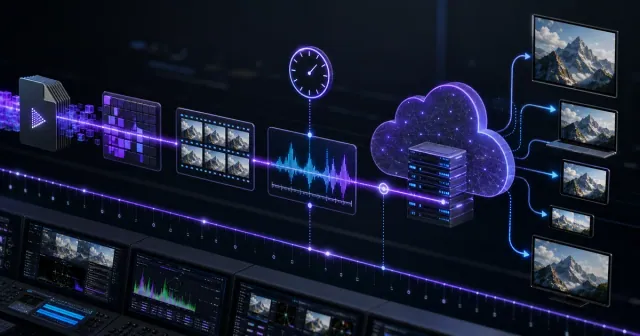
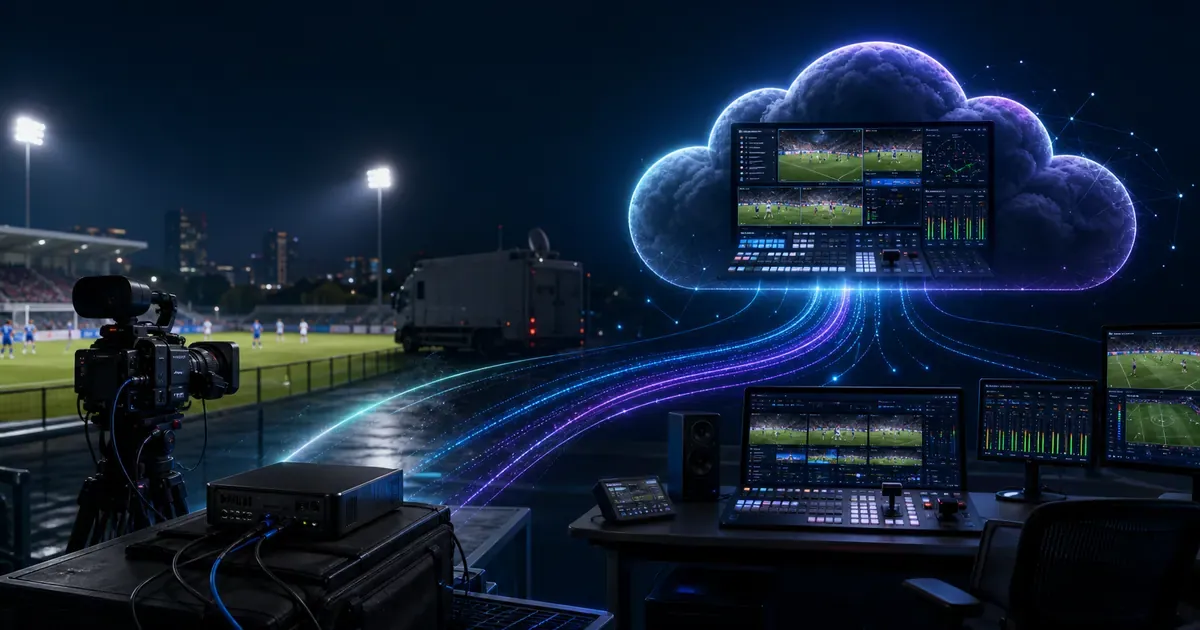
A traditional OB truck concentrates routing, vision mixing, audio, graphics, replay, monitoring and engineering at the venue. An IP production model separates the cameras and essential edge equipment from the processing and control plane. Encoders turn camera outputs into contribution streams; diverse network paths carry them to production resources; operators control software switchers and other applications from a remote gallery.
The distinction matters because remote production is not simply a video call with better cameras. The workflow must preserve source identity, timing, tally, intercom, return video and deterministic control. Standards such as SMPTE ST 2110 describe professional media transported as separate video, audio and ancillary flows, while AMWA NMOS provides discovery, registration and connection management for networked resources (AMWA NMOS technical overview).
The Venue Becomes an Edge, Not an Empty Space
Cameras, microphones, local monitoring, contribution encoders and resilient connectivity still need to be on site. Some productions also retain a small technical operations position for confidence and rapid fault isolation. What changes is the amount of specialized processing hardware, cabling, power and crew that must travel for every event.
Warner Bros. Discovery Sports described the old model as sending 20 or more people alongside OB and satellite trucks. Its cloud approach keeps camera operators at the venue while feeds travel over 4G, 5G or cabled internet to production resources elsewhere. The same platform has supported between 600 and 700 remote commentary sessions in a normal week and scaled to 14,000 sessions for a major international event (AWS and WBD Sports case study).
Why Broadcasters Are Reducing Their Dependence on OB Trucks
More Events Can Share the Same Production Resources
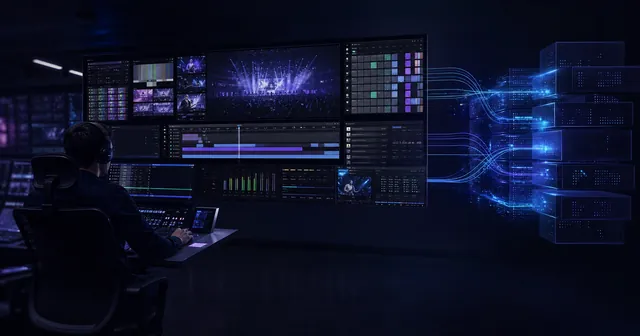
A truck is an excellent production environment, but it is a fixed asset in one place. Software-defined production lets switchers, multiviewers and graphics engines be allocated when required and reused across events. Operators can work from familiar control surfaces while the processing runs in a central data centre or cloud region. This makes smaller sports, regional events and pop-up channels more viable because every production does not begin with the full cost of a large mobile facility.
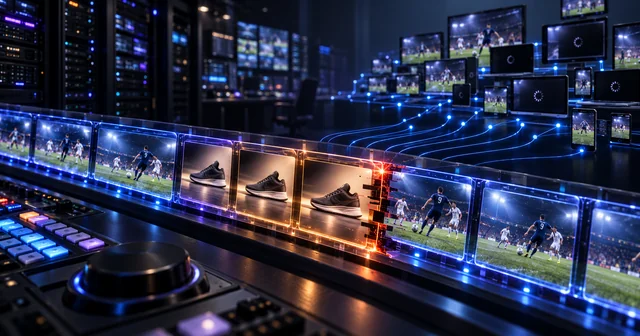
Sony demonstrated the scaling advantage in 2026 with a cloud-based sports production handling more than 90 live sources. Eight cloud switchers could each see only 32 pre-selected inputs, so Sony placed cloud routing upstream and made all sources dynamically available without adding physical pre-selector routers. The result supported multiple simultaneous programmes and flexible failover while reducing racks, cable runs, equipment shipments and setup complexity (AWS and Sony cloud production architecture).
Contribution Can Use the Public Internet Without Treating It as Infallible
Protocols such as SRT use retransmission and configurable latency to carry reliable video across imperfect networks. 5G and bonded cellular add practical venue options. But internet contribution is an engineered service, not a shortcut: teams need path diversity, measured round-trip time, enough recovery buffer, bandwidth headroom, continuous telemetry and a rehearsed fallback.
Fuji TV's 2026 winter sports production is a useful example. Eight cameras were encoded as 20 Mbps H.265 SRT feeds and sent over two bandwidth-guaranteed public internet circuits to AWS Frankfurt. Switching, audio mixing and graphics ran in the cloud, with a Paris-region backup path. AWS reports approximately 1.7 seconds of end-to-end cloud delay, 45% lower network cost than the previous dedicated-line model, and a 21% reduction in technical setup time (AWS and Fuji TV live cloud production case study).
The Hard Problems Have Moved, Not Disappeared
Cloud switching replaces physical constraints with orchestration and observability requirements. Every source needs a clear clock relationship. Operators need low-latency multiviewers, responsive controls, return video, talkback and confidence monitoring. Security must cover identities, APIs and contribution endpoints. Redundancy must include regions, networks and control paths rather than duplicating only the final encoder.
Interoperability is also unfinished work. The EBU noted in 2025 that software-based live production is now real, but products may still exchange media through repeated ST 2110, SRT or NDI conversions. Those transitions can add processing, energy use and latency, which is why initiatives such as the Media eXchange Layer are working toward more efficient in-memory exchange between production applications (EBU tech-i, June 2025).
A Practical Migration Pattern
Start with a production whose economics are constrained by the truck: a secondary sports feed, a regional match, a remote interview programme or an event that needs several localized outputs. Keep a conventional fallback while the team proves five things:
- Contribution: dual paths remain stable under realistic loss, jitter and congestion.
- Timing: camera, audio, graphics and replay arrive synchronized.
- Operations: multiview, tally, talkback and controls feel predictable to the crew.
- Resilience: failover is rehearsed across encoders, networks, regions and operators.
- Economics: the model reduces travel and fixed capacity without hiding variable cloud or connectivity costs.
Once those controls are repeatable, the same production template can serve more events. That repeatability, rather than the mere absence of a truck, is the real operational breakthrough.
Conclusion: The Truck Becomes a Choice
IP-based live switching does not make OB trucks obsolete. Top-tier productions may still need their density, local autonomy and proven ergonomics. What changes is that a truck is no longer the automatic starting point for every credible live broadcast.
With resilient IP contribution, software switching and centralized control, broadcasters can match the production footprint to the value of each event. Evrideo Outpost supports reliable SRT contribution, routing and stream manipulation, while StudioCloud brings live production workflows into the cloud. Together they help teams build lighter, repeatable live operations without relaxing broadcast standards.