What Is a Playout Server? Why Broadcasters Move to Cloud
A playout server is the system that turns a schedule and a library of media into the continuous television channel audiences see. It plays programmes at the correct time, switches to live feeds, inserts advertisements and graphics, preserves captions and audio layouts, and produces an output that downstream broadcast and streaming systems can trust.
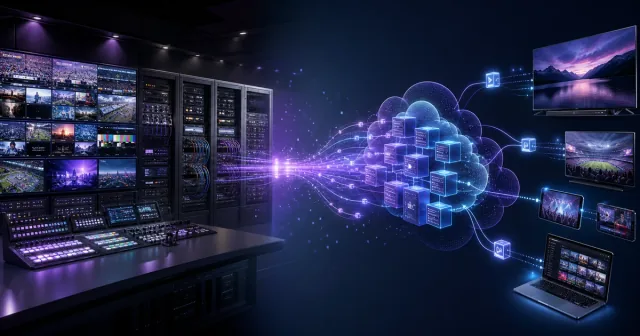
For years, that job was usually assigned to dedicated hardware inside a broadcast facility. Those appliances remain effective, but broadcasters now need more channels, more output formats and faster launches. That is why playout servers are increasingly becoming software services that can run on-premises, in a private cloud or in public cloud infrastructure.
What Does a Playout Server Actually Do?
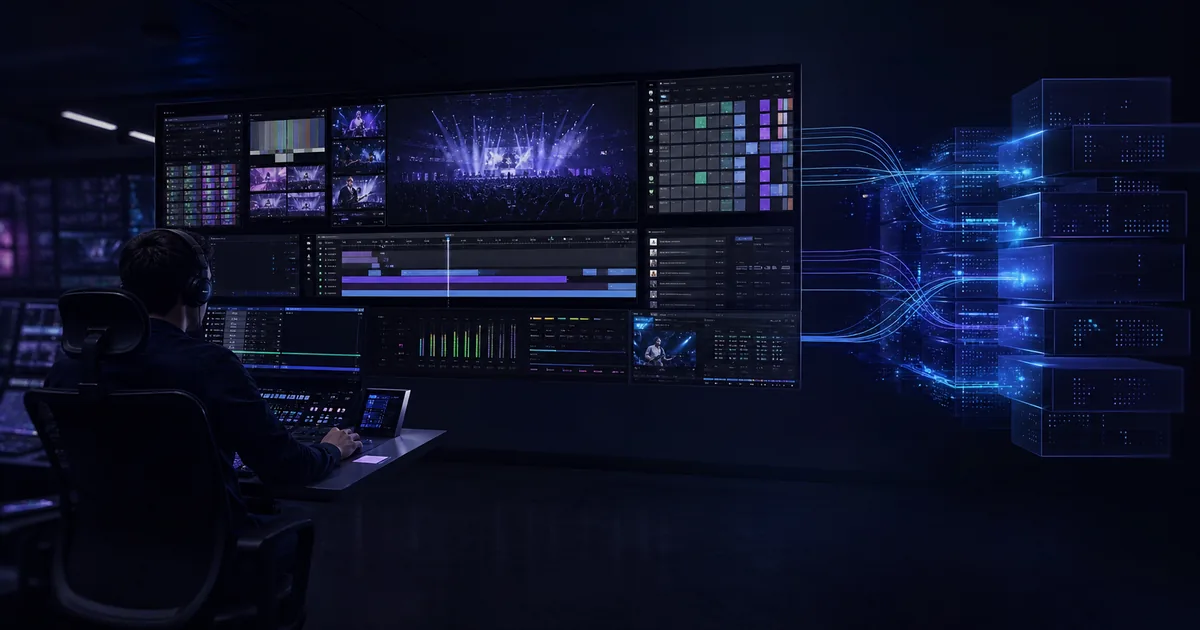
A playout server sits near the end of the broadcast supply chain. Upstream systems prepare media, metadata and schedules. The playout server follows the running order and creates the linear output. Depending on the channel, its responsibilities can include:
- Scheduled playback: frame-accurate transmission of programmes, promos, idents and advertisements.
- Live switching: moving cleanly between recorded material and news, sport, studios or remote feeds.
- Branding and graphics: channel logos, lower thirds, clocks, tickers and emergency messages.
- Audio and accessibility: language tracks, loudness control, captions, subtitles and audio description.
- Signalling: markers such as SCTE-35 for downstream ad insertion and distribution events.
- Continuity: fallback content, playlist validation, alarms and recovery when an asset or source fails.
Playout is therefore more than pressing play. The server must interpret automation instructions, retrieve the correct assets, process them in real time and keep timing predictable across every transition. A useful architectural description appears in the ITU's 2024 report on cloud programme production: cloud playout uses software switchers, encoders and multiplexers, with signals and alarms monitored at each processing point (ITU-R BT.2539-0).
The playout server is one part of channel origination
The terms playout, automation, master control and channel origination are often used together, but they are not identical. Automation manages schedules and device commands. The playout engine renders the channel. Master control adds operational supervision, switching and compliance. Channel origination describes the complete function, including media management, graphics, monitoring and distribution handoff.
Why the Dedicated Hardware Model Is Under Pressure
A traditional playout server is sized before deployment. Engineers choose channel count, video format, graphics capability, redundancy and storage, then buy enough hardware for the expected peak. That delivers a controlled environment, but it also locks capacity and capital into a design that may need to serve the next five to seven years.
New requirements rarely arrive in that order. A broadcaster may win temporary sports rights, launch a FAST channel, add a regional version or support a new distribution partner with different codec and caption rules. If every change requires another appliance, rack space, integration project and maintenance contract, channel experimentation becomes slow and expensive.
SMPTE research on channel origination as a service describes the underlying problem: on-premises systems require periodic replacement and capital planning even as storage, processing and networking needs become harder to forecast. The paper concludes that virtualised channel functions can still support frame-accurate switching between files, linear schedules and live content (SMPTE Motion Imaging Journal).
How a Cloud Playout Server Changes the Model
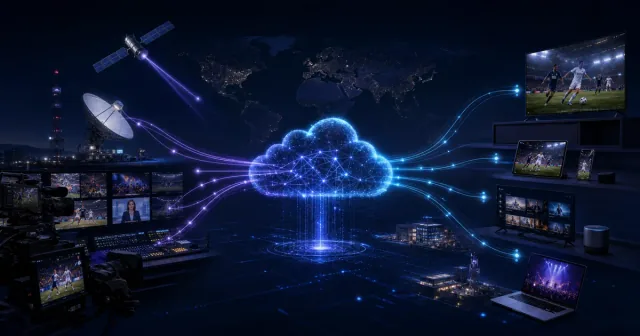
A cloud playout server separates the channel software from a specific physical appliance. Media can reside in object storage, schedules can be managed through a browser, and playout resources can be deployed from repeatable templates. Outputs may return to terrestrial or cable infrastructure, travel over managed IP, or feed OTT and FAST distribution directly.
The EBU's 2026 Dynamic Media Facility reference architecture places this shift inside a broader software-defined model: media applications should be deployable across on-premises, private-cloud and public-cloud infrastructure, with orchestration and observability separated from the underlying compute (EBU Dynamic Media Facility). That portability matters because “cloud” should describe an operating model, not a forced destination.
Cloud brings flexibility, not automatic reliability
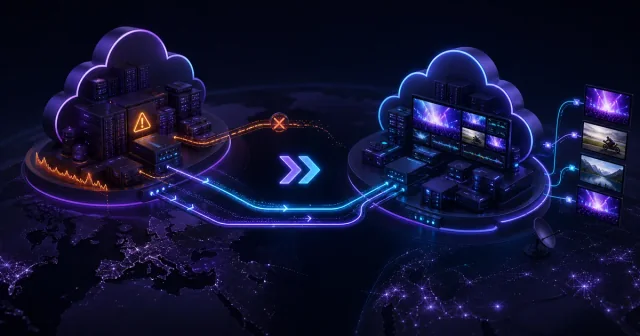
Moving software to a cloud region does not make a channel resilient by itself. A production design still needs independent failure domains, redundant inputs and outputs, tested state recovery, monitoring outside the playout stack, and operators who can act on meaningful alarms. The ITU report recommends placing backup systems in a different region or availability zone for critical broadcast infrastructure.
Cost also needs modelling. Always-on premium channels may run continuously enough that owned infrastructure remains economical. Cloud can be especially attractive for pop-up channels, disaster recovery, regional variants and portfolios where resources can be standardised across many services. Storage retrieval, data transfer, premium support and idle redundancy all belong in the calculation.
A Practical Example: Launching a Regional Channel
Consider a broadcaster that already runs one national channel and needs a regional version for a three-month competition. The new service shares most programmes but has regional advertisements, local promos, a different live match on selected evenings and separate SCTE-35 markers for its streaming partner.
With a hardware model, the project may require another playout appliance, redundant spare capacity and an integration window in the facility. With software-defined cloud playout, the operations team can clone an approved channel template, connect the shared media library, apply a regional schedule and deploy two independent playout paths. After the competition, the resources can be retired while the configuration remains available for the next event.
AWS demonstrated this pattern at NAB 2025 by originating both an over-the-air ATSC 3.0 service and an OTT FAST channel from cloud-based channel and master-control components. This is a vendor-produced demonstration rather than independent evidence of savings, but it usefully illustrates how archived content, live sources, advertising and different delivery paths can share one software-defined workflow (AWS NAB 2025 channel-origination demonstration).
When Should You Replace a Playout Server?
Do not migrate merely because the current server is called “legacy”. Start with operational evidence. A change is worth evaluating when hardware is approaching end of support, new channels take months to launch, teams maintain duplicate broadcast and streaming workflows, disaster recovery cannot be tested safely, or capacity is stranded between short-lived events.
Then test the target model against the real channel:
- Can it reproduce every transition, graphic, caption, audio and signalling requirement?
- How quickly does it recover from missing media, lost inputs and regional failure?
- Can operators monitor and control multiple channels without losing clarity?
- What is the full three-to-five-year cost, including connectivity, storage and support?
- Can the broadcaster move workloads or data if commercial requirements change?
A phased hybrid migration is often the sensible answer. Start with disaster recovery, a secondary channel or a temporary service. Prove the operating model, train the team and measure costs before moving the most complex primary channel.
Conclusion: Playout Is Becoming a Software Capability
A playout server remains the engine that turns schedules, media and live sources into a dependable channel. What is changing is the assumption that the engine must be a dedicated box in one building.
Cloud and software-defined playout can shorten launches, standardise operations and let capacity follow the channel portfolio. On-premises and hybrid systems still make sense where economics, connectivity or control demand them. Evrideo Broadcast brings playout, master control, automation and multi-platform distribution into one cloud-native environment, helping teams modernise at the pace their channels and risk profile allow.