
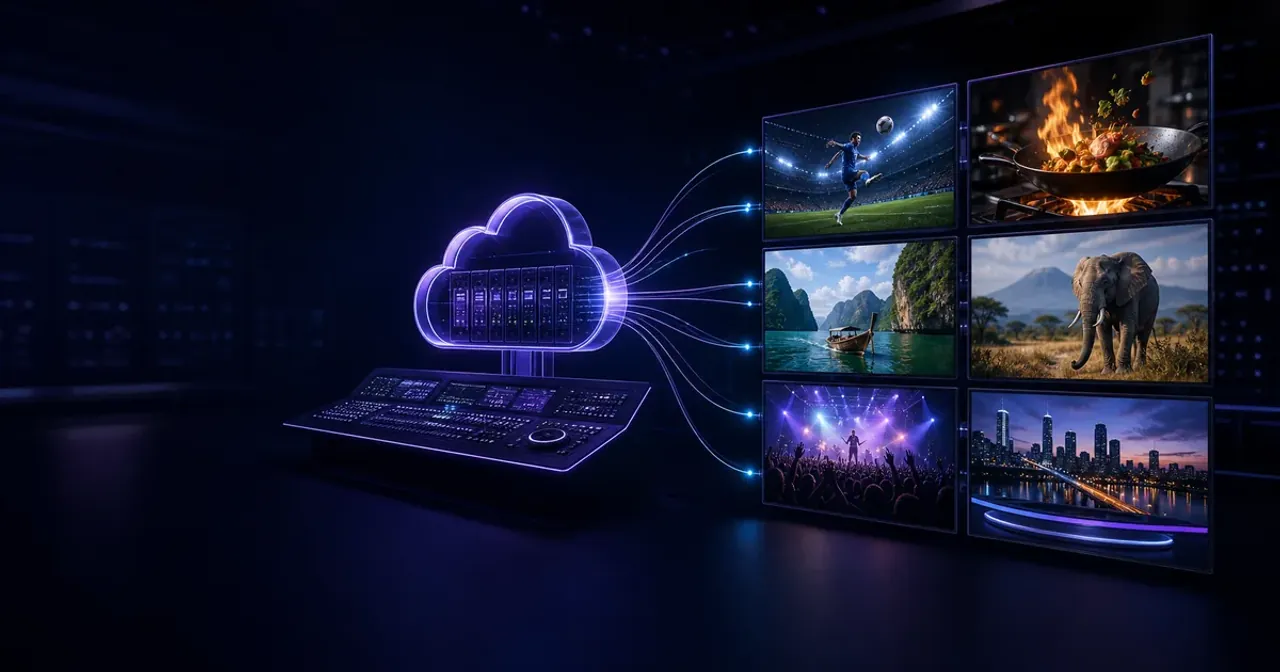
The Rise of Micro-Channels: Why Focused Linear TV Is Winning Attention
The next growth phase in streaming television may be smaller than the last one. A micro-channel is a tightly programmed linear service built around a specific genre, audience, personality, region or viewing occasion. Instead of trying to be everything to everyone, it gives a defined group of viewers a dependable place to watch something they already care about.
The timing is favourable. Gracenote's May 2026 Data Hub counted 2,120 FAST channels worldwide, up 19% in a year, with sports, news and reality among the most prominent genres outside general entertainment (Gracenote Data Hub). That growth does not prove that every narrow channel will succeed. It does show that distribution platforms and audiences increasingly accept television as a collection of focused services rather than a small set of broad networks.
Why the Micro-Channel Model Fits a Fragmented Market
Broad channels were built for scarcity. When viewers had a limited number of destinations, a schedule needed enough variety to hold many demographics across the day. Streaming reversed that constraint. A platform can carry hundreds of channels, while search, recommendations and electronic programme guides can connect each viewer to a more relevant one.
Focus creates a clearer promise. A channel dedicated to women's football, classic motorsport, regional news, independent horror, home renovation or a single long-running franchise is easy to describe. That clarity helps viewers decide, platforms categorize the service, and advertisers understand the context in which their message will appear.
Audience size is only half the commercial equation
A micro-channel does not need to beat a general entertainment network on total reach. It needs to assemble enough repeat viewing at a sustainable cost. A smaller audience with a recognizable interest may create more useful sponsorship packages, stronger contextual relevance and better retention than a larger but weakly defined audience.
Advertising demand is moving toward digital video at the same time. IAB projects U.S. digital video advertising to exceed $80 billion in 2026 and account for more than 60% of total TV and video ad spend (IAB 2026 Digital Video Ad Spend report). A focused channel gives buyers a coherent editorial environment, while server-side ad insertion can still adapt campaigns by geography, platform or audience segment.
Focused Programming Is More Than a Narrow Catalogue
A folder of similar programmes is not yet a channel. The schedule needs rhythm: recognizable dayparts, sensible episode rotation, seasonal events, live moments and enough variation to avoid exhausting the library. Metadata also needs to be accurate so programme guides, recommendations and contextual advertising can understand what is playing.
Gracenote's 2025 FAST analysis found that active channel numbers across the U.S., U.K., Germany and Canada had nearly doubled since mid-2023. It also found that reality channels grew from 19 to 138 in eight months, while sports channels more than doubled in a year to 220 (Gracenote 2025 FAST report). The lesson is not simply that more channels exist. It is that specific programming propositions can expand quickly when the content, audience and distribution opportunity align.
Micro does not mean low quality
Viewers still expect broadcast-grade continuity. The channel must start on time, survive missing media, preserve captions and audio, signal ad breaks correctly, and reach every distribution endpoint in the required format. A narrow editorial proposition can be operationally sophisticated, particularly when it includes live events, regional rights, multiple languages or partner-specific outputs.
The Economics Changed: Build Once, Test, Then Scale
Historically, launching a linear channel meant committing to dedicated playout, monitoring, distribution and operational staffing before demand was proven. That favoured broad propositions able to justify a large fixed cost. Cloud-native playout changes the threshold. Scheduling, graphics, live inputs, compliance, ad signalling and output profiles can be configured in software, allowing a content owner to test one market or platform before expanding.
A useful measure of software-defined scale comes from BT. In its cloud OTT modernisation, BT migrated 213 linear channels in 12 months and reduced new-channel build times from days or weeks to hours. AWS also reports that cost-analysis turnaround fell from about a day to roughly 10 minutes (AWS BT case study). The lesson is not simply that cloud can carry more channels. Repeatable configuration and visible operating costs make it practical to test a focused service before committing to wider distribution.
The practical model is iterative:
- Start with a defined audience and library: know the viewer promise, available rights and realistic schedule depth.
- Launch a controlled version: begin with one territory, platform or commercial model and measure viewing, retention, fill and operating cost.
- Improve the schedule: use actual programme performance to change rotations, dayparts and promotional placement.
- Scale successful formats: add languages, regions, live windows or partner-specific outputs without rebuilding the channel.
A Concrete Example: One Archive, Three Focused Services
Consider a content owner with a large factual library covering travel, food and wildlife. A single general factual channel makes the catalogue easy to distribute, but its audience promise is vague. The same rights package could support three micro-channels with clearer identities: destination travel during planning hours, practical cooking around meal times, and premium wildlife in family evening slots.
The owner should not launch all three blindly. It can begin with the strongest library and market, validate schedule depth and distribution demand, then reuse the operational blueprint for the next service. Shared infrastructure can handle media management, playout, monitoring and monetisation while each channel retains its own brand, schedule and commercial positioning.
What Separates a Durable Micro-Channel From More Clutter
Focus alone is not a strategy. A durable micro-channel needs enough content to sustain repeat viewing, clear rights for the intended territories, reliable metadata, measurable distribution, and an advertising or licensing model appropriate to its audience. It also needs active programming. Even a deep archive feels shallow when the same episodes recur at the same times without editorial intent.
The strongest propositions usually combine a recognizable promise with one reason to return: live coverage, premieres, seasonal stunts, topical refreshes, talent, community or genuinely useful curation. That return mechanism turns a themed playlist into a television brand.
Conclusion: Smaller Channels Can Create a Clearer Business
The rise of the micro-channel is not the end of broad television. It is a response to a market where distribution capacity is abundant, attention is fragmented and content owners need more precise ways to package their libraries. Focus can make a channel easier to discover, easier to position and easier to test, provided the programming and operations meet the same standards as any larger service.
Evrideo Broadcast gives content owners one cloud-native environment for scheduling, playout, live inputs, monitoring and multi-platform distribution. It makes it practical to launch a focused linear or FAST service, learn from real audience behaviour, and scale the formats that earn attention.
Related Articles
Five Signs Your Broadcast Infrastructure Is Holding Back Revenue
July 17, 2026 · 7 min read
FAST in 2026: What Works, What Fails and What Comes Next
July 31, 2026 · 8 min read
Managed broadcast services or self-operated SaaS?
October 16, 2026 · 6 min read