
Swipe or Watch? How FAST Channels Simplify Content Discovery
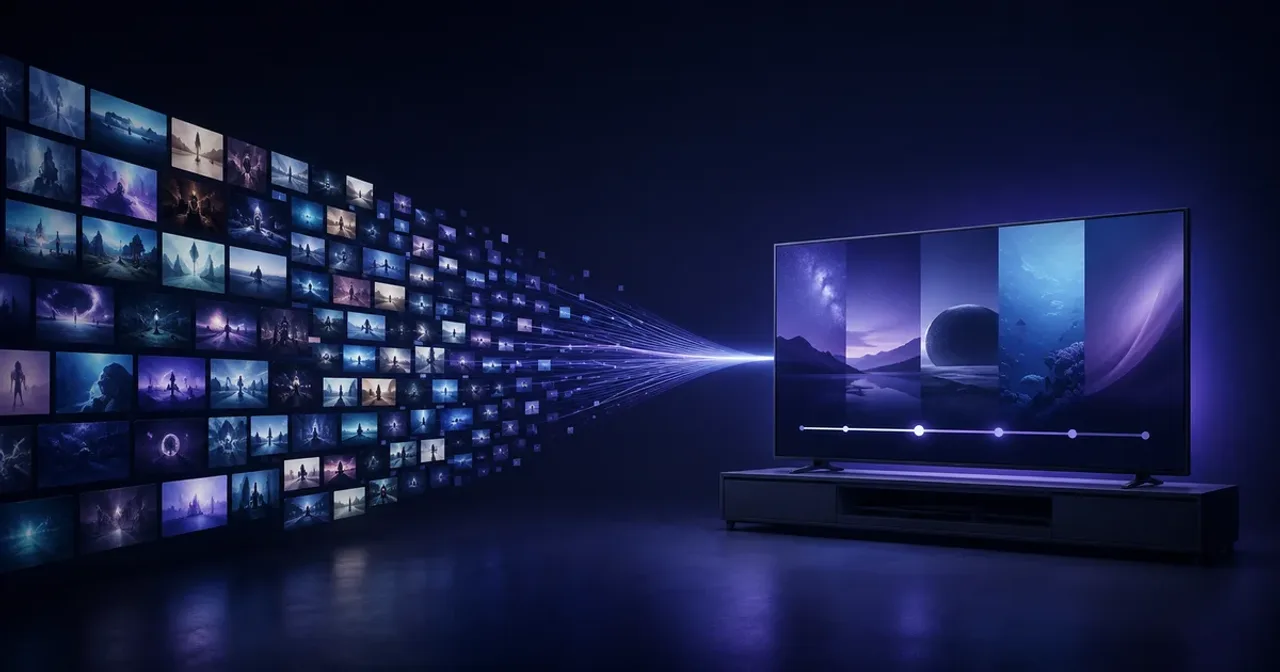
Streaming gave viewers almost unlimited choice, but it did not make choosing easy. A home screen can present thousands of programmes and still leave somebody swiping through rows instead of watching. Well-designed FAST channels can reduce that discovery friction by replacing a title-by-title decision with a simpler proposition: choose a channel that matches your mood and start watching immediately.
The problem has measurable commercial consequences. Nielsen's Gracenote surveyed 3,000 streaming viewers across six countries in 2025 and found that people spent an average of 14 minutes searching for something to watch. Nineteen percent abandoned a viewing session after an unsuccessful search, while 49% said difficulty finding content could make them cancel a service (Nielsen Gracenote, 2025 State of Play findings). For an advertising-funded platform, every abandoned session also removes potential viewing time and ad inventory.
Why FAST Channels Can Simplify Content Discovery
On-demand interfaces ask the viewer to evaluate individual titles. What is this programme? Is it worth starting? How long is it? Will everyone in the room agree? A FAST channel packages those decisions into a recognisable editorial promise. A comedy channel, classic crime channel or live-news service tells the viewer what kind of experience to expect without requiring a commitment to a specific episode.
This is closer to choosing a restaurant than choosing every ingredient. The schedule, pacing and channel identity do part of the decision-making on the viewer's behalf. The viewer can sample what is on now, stay if it works, or move to another channel with very little effort.
Linear viewing turns choice into momentum
A scheduled stream has an immediate advantage over a catalogue tile: it is already playing. Joining a programme in progress removes the pressure to make the perfect selection and creates opportunities for viewers to encounter titles they would never search for by name. That makes FAST useful as a discovery layer for archive programming, specialist genres and unfamiliar brands.
There is evidence that viewers are responding to this simplicity. Gracenote reported that one-third of streaming viewers in its six-country survey were spending more time with FAST programming because the wider streaming landscape had become overwhelming. Its August 2026 Data Hub counted 2,172 FAST channels distributing more than 225,000 movies, shows and sports titles worldwide (Gracenote analysis of streaming congestion; Gracenote Data Hub).
FAST can introduce the catalogue, not compete with it
The strongest design does not force a choice between linear and on-demand. A viewer might discover a series on a themed channel, open its programme page, add it to a watchlist and continue from episode one later. Live rows, programme guides, recommendations and deep links can turn the channel into a moving shop window for the wider library.
Current Fire TV integration guidance shows how this works at platform level. Linear services can appear in the Channel Guide and On Now row, while programme metadata, preview images, progress information and deep links help viewers understand and launch the content (Amazon Fire TV linear-app guidance). The commercial lesson applies beyond one device: distribution is more valuable when channel metadata travels far enough to power discovery outside the channel app.
A FAST Channel Is Not Automatically Easy to Discover
Adding hundreds of poorly differentiated channels to another long grid simply moves the problem. The channel needs a concise promise, accurate schedule data, useful artwork and enough programming coherence for viewers to understand why they should return. A generic name such as “Entertainment 12” asks the audience to do too much interpretation.
Metadata quality is operational, not cosmetic. Titles, episode descriptions, genres, ratings, captions, start times and stable identifiers determine whether a programme appears correctly in guides, search and recommendations. The schedule must also reflect what is actually playing. A compelling tile that opens the wrong programme damages trust faster than a plain but accurate listing.
Social discovery and channel discovery should reinforce each other
Many viewing journeys now begin away from the television home screen. Deloitte's 2025 Digital Media Trends study found that 56% of younger respondents watched a programme or film on a subscription streaming service after hearing about it from online creators, and 53% said social media gave them better viewing recommendations (Deloitte, 2025 Digital Media Trends). FAST operators should therefore connect clips, talent, moments and programme pages back to a channel that is easy to find and join.
The reverse journey matters too. A channel can expose an unfamiliar programme, then offer a QR code, app deep link or on-demand destination for viewers who want more. Discovery becomes a loop across social, FAST and VOD rather than a single recommendation row.
A Practical Example: Turn One Factual Library into a Discovery Engine
Consider a content owner with 800 factual episodes spanning engineering, transport, history and adventure. Publishing every episode into one VOD catalogue creates depth, but the less famous titles may remain invisible. The owner instead launches three clearly defined FAST channels: Engineering Stories, Great Journeys and Modern History.
Each channel has a dayparted schedule, recognisable artwork and complete now-and-next metadata. Short promotional clips link to the live stream. Programme pages offer full-series VOD where rights allow. The operator promotes individual theme weeks rather than asking audiences to browse all 800 episodes.
This example is illustrative, but its measurement plan should be real. Track home-screen impressions, channel starts, time to first play, average minutes viewed, return frequency, programme-page visits and FAST-to-VOD conversion. Compare those figures by channel proposition and schedule block. A channel that generates starts but no repeat viewing may be easy to sample yet poorly programmed.
Build the Channel Around the Viewing Decision
Ofcom's 2025 Media Nations report describes UK broadcasters developing their streaming services into standalone discovery hubs and notes Channel 5's addition of themed FAST channels when it relaunched My5 as 5 (Ofcom Media Nations 2025). The useful principle is not to copy a particular interface. It is to connect live channels, on-demand titles and a consistent brand so the viewer can move between them without starting a new search.
For content owners, that requires more than generating a continuous stream. Programming, metadata, graphics, rights, ad signalling, distribution and monitoring must operate as one product. The channel should be easy for platforms to ingest, easy for guides to describe and reliable enough that a viewer's first low-friction click becomes a habit.
Conclusion: FAST Channels Should Convert Browsing into Viewing
FAST channels can simplify content discovery because they offer an immediate, curated answer to “what should I watch?” They work best when the editorial promise is specific, the schedule is coherent, metadata is complete, and the live experience connects naturally to clips and on-demand viewing.
Evrideo Broadcast brings broadcast workflows to FAST by combining channel creation, scheduling, playout, metadata, ad signalling and multi-platform delivery in one cloud-native platform. The aim is not merely to put another channel in a grid. It is to turn a content library into a service that viewers can understand, start and return to.
Related Articles
The Cheapest OTT Content May Be a Linear TV Channel
August 28, 2026 · 7 min read
Broadcasting with a SaaS Business Model: Channel Economics
September 17, 2026 · 6 min read

Managed broadcast services or self-operated SaaS?
October 16, 2026 · 6 min read