

Everything You Need to Know About DRM for Video Streaming
Encryption makes a video unreadable. Digital rights management decides who may make it readable, on which device, at what quality and for how long. That distinction matters. A copied encrypted segment is harmless only while the content key remains protected and the playback policy is enforced. DRM for video streaming is therefore a complete control system rather than a single encryption switch.
The major consumer systems are Google Widevine, Apple FairPlay Streaming and Microsoft PlayReady. They are not interchangeable, but standards connect the workflow: W3C Encrypted Media Extensions (EME) links applications to a Content Decryption Module (CDM), Common Encryption protects fragmented MP4 media, and CPIX or SPEKE carries keys and signalling to a packager.
How DRM for Video Streaming Works
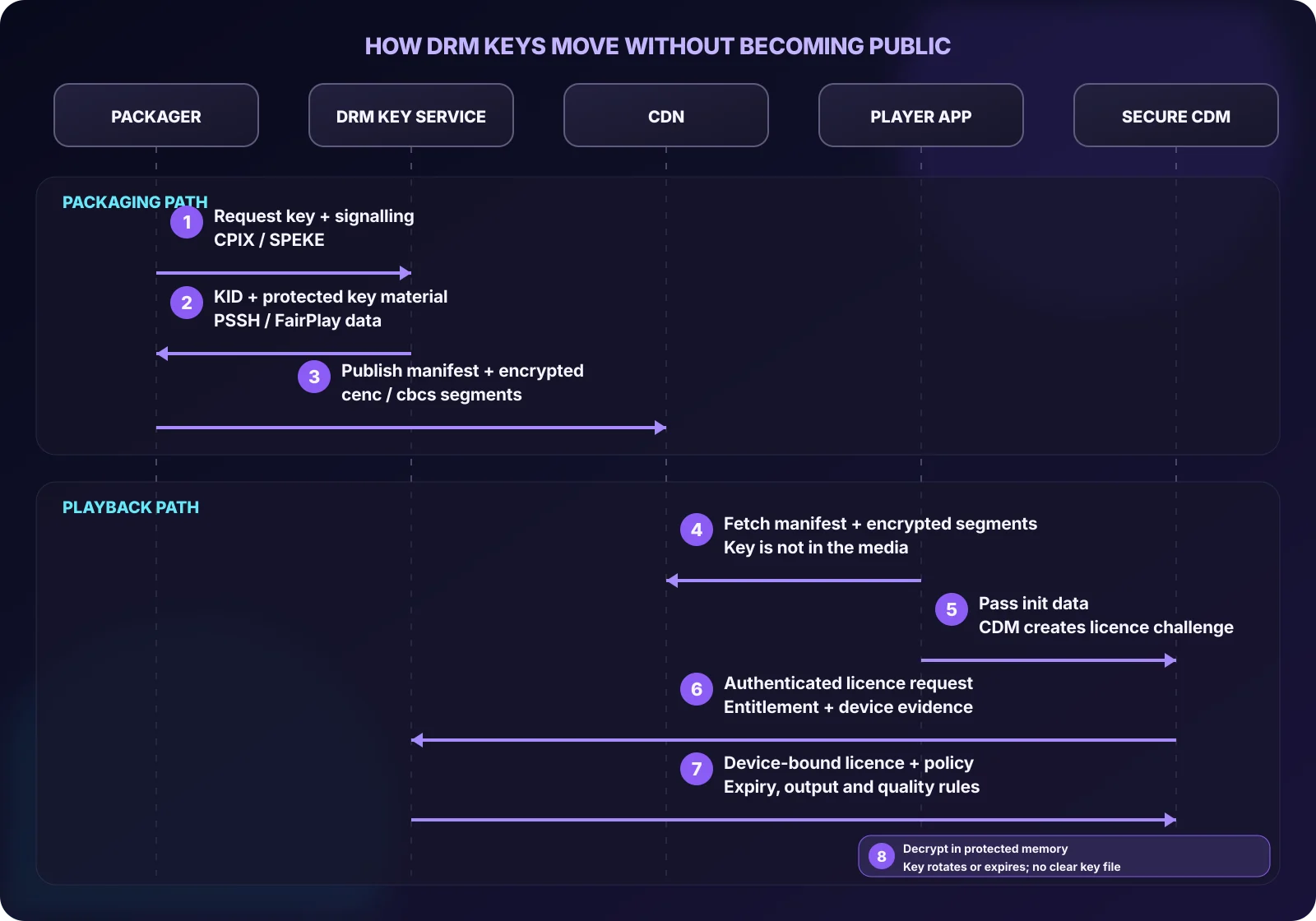
A DRM workflow has two related but separate paths. During packaging, the encryptor obtains a content key and signalling information from a trusted key service. During playback, the viewer's device obtains a licence that permits its CDM to use the corresponding key under defined rules. The raw key is never placed in the manifest or media segment.
1. The packager obtains a key securely
The packager requests protection information through DASH-IF CPIX or an API such as AWS SPEKE. The response associates a random content key with a Key ID and supplies DRM-specific signalling, potentially for several key-rotation periods.
The packager encrypts the samples using cenc or cbcs, then publishes the manifest and encrypted segments. The manifest exposes identifiers and licence information, never a reusable clear key, so the CDN can deliver media without being able to decrypt it.
2. The player requests permission, not a naked key
The player asks its CDM to create a licence challenge and sends it with authentication or entitlement evidence. The service evaluates the subscriber, device, territory, viewing window, output protection and permitted resolution before returning a device-bound licence.
The W3C EME specification keeps decryption inside the CDM. During normal online playback, key material is unwrapped in protected memory rather than exposed to JavaScript or saved as a reusable file. Persistent offline licences store device-bound protected state, not a portable clear key.
Widevine vs FairPlay vs PlayReady
There is no universal winner because device support determines the answer. Most services use multi-DRM: one encrypted media set where compatible, with several DRM signalling and licence paths.
| Option | Primary reach | Packaging and security | Commercial considerations |
|---|---|---|---|
| Google Widevine | Chrome, Firefox, Android, Chromecast, Fire OS and many connected TVs | Common Encryption with software and hardware-backed security tiers; broad support for cenc and cbcs. | Google lists no Widevine access or transaction fee, but agreements, integration, managed services and support still cost money. |
| Apple FairPlay Streaming | Safari, iPhone, iPad, Apple TV and Apple playback environments | HLS-focused key delivery, commonly using cbcs with fragmented MP4. | Production credentials require Apple approval; budget for the key service, integration and Apple-device testing. |
| Microsoft PlayReady | Windows, Edge, Xbox, smart TVs and operator devices | Detailed expiry, security-level and output policies; SL3000 supports hardware-backed protection. | Licensing is scenario-specific for servers, clients, encoding and distribution. |
| Clear Key or AES-128 | Testing, internal services and lower-value content | Encryption without the hardware security and policy enforcement expected for premium rights. | Lower complexity, but usually unacceptable to premium rights holders and not equivalent to multi-DRM. |
Always validate the exact operating-system versions, codecs, resolution, HDCP capability, hardware security and offline requirements in the launch matrix. A browser name alone does not guarantee a particular DRM policy will work.
The Commercial Comparison Is Bigger Than a Licence Price
Total cost includes packaging, key storage, licence transactions, entitlement integration, player work, device certification, monitoring and support. Compare platform minimums, per-licence charges, concurrency, regions, offline rights, SLA and support. A managed multi-DRM service reduces specialist operations; self-operation offers control but makes availability, security and device compatibility your responsibility.
Technical DRM Gotchas That Break Playback
Content and ads may not share the same protection or encode
DRM on the programme does not guarantee that inserted ads use the same encryption model. AWS MediaTailor, for example, signals METHOD=NONE for unencrypted ads and restores the content key tag afterwards; other SSAI stacks encrypt both content and ads. Either approach can work, but every boundary must be signalled and tested deliberately.
Encryption is only half the transition. An ad with a different codec, profile, container, audio layout, segment cadence or initialization segment can break a player even when the personalized manifest looks valid. AWS documents NO_VARIANT_MATCH when bitrate, resolution or codec does not match, while its dynamic transcoder notes that codec-profile matching does not guarantee codec-level matching. Precondition the ad ladder against the content ladder and test encrypted-to-clear and encrypted-to-encrypted transitions on real devices.
Encrypted-stream monitoring needs two planes
A conventional probe cannot perform unrestricted decoded-frame QC after packaging because the EME security model keeps decryption inside the client CDM. Operations therefore need two complementary monitoring planes. Monitor the delivery plane structurally: packager key requests, KID changes, manifests, encryption signalling, segment availability, licence latency and player errors. Separately, run authorized synthetic playback clients with valid entitlements across representative CDMs and device classes. Keep unrestricted frame, audio and compliance QC before encryption, and never place clear content keys in logs or monitoring payloads.
Rotation, periods and discontinuities must agree
Key rotation is a distributed state change across the key service, packager, manifest, CDN and player. Publishing a new KID or segment before the matching licence path is ready causes stalls. Ad insertion makes that timing harder: HLS requires discontinuity signalling when encoding parameters change, while DASH commonly uses Period boundaries to update DRM or codec configuration. Align the crypto-period, segment boundary, manifest update and licence availability, then test the beginning and end of the live window.
Policy failures often look like media failures
- CORS and secure-origin errors: cross-origin media needs the correct CORS response and player configuration before EME initialization data is available.
- HDCP and security-level rules: an otherwise valid licence can produce a black screen when the display path or device security level cannot satisfy the policy.
- Clock and expiry problems: incorrect trusted time, short licence duration or failed renewal can stop playback mid-programme.
- Personalized-manifest caching: a CDN cache key that ignores authorization or session parameters can serve the wrong DRM or SSAI state to another viewer.
Conclusion: Treat DRM as a Playback System
Effective DRM uses rotating content keys, encrypted media, device-bound licences, secure CDMs and explicit rights policies. Widevine, FairPlay and PlayReady cover different device markets, so premium services normally need coordinated multi-DRM plus operational testing of every encryption, ad and device boundary.
Evrideo's cloud-native workflows can connect packaging, distribution and external DRM services as part of a managed broadcast operation. Explore Evrideo integrations or speak with our team about designing a protected live, linear, FAST or VOD delivery workflow.
Related Articles

Maximising Video Ad Revenue Across Linear, OTT and FAST
August 24, 2026 · 8 min read

Shoppable TV: What Early Adopters Have Learned
September 18, 2026 · 6 min read
Broadcasting with a SaaS Business Model: Channel Economics
September 17, 2026 · 6 min read