Cloud Playout vs Traditional Master Control: How to Choose
The choice between cloud playout and traditional master control is not simply software versus hardware. It is a decision about how a broadcaster wants to buy capacity, operate channels, manage failure and respond to change. A cloud design is not automatically cheaper or more resilient, while an on-premises system is not automatically obsolete.
The right answer depends on the network. A stable national channel with specialised local inputs may justify dedicated infrastructure for years. A portfolio launching temporary, regional or FAST services may benefit far more from on-demand resources and remote operations. The useful comparison starts with the operating model, not the sales label.
What Cloud Playout and Traditional Master Control Mean
A traditional master control facility normally places automation, playout, switching, graphics, monitoring and routing in a broadcaster-controlled site. Signals may move over SDI or a managed IP fabric. The SMPTE ST 2110 standards suite shows why on-premises should not be confused with old technology: modern facilities can carry separate, precisely timed video, audio and ancillary-data flows over managed IP networks.
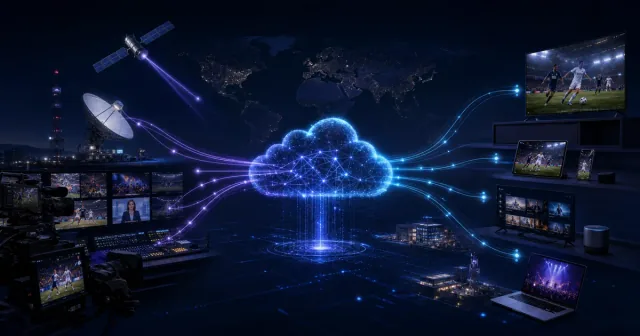
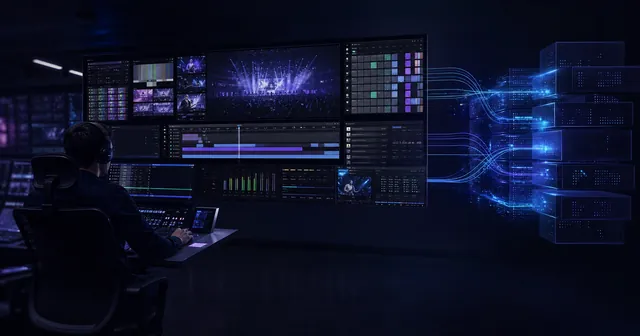
Cloud playout moves some or all of those functions into virtualised software running on shared infrastructure. Inputs and outputs are normally IP-based, operators can work remotely, and processing capacity can be provisioned through software. ITU-R BT.2539-1 describes cloud programme production using virtualised switchers, encoders and multiplexers, with remote monitoring of signals and fault alarms.
Cloud Playout vs Traditional Master Control at a Glance
| Decision area | Traditional master control | Cloud playout |
|---|---|---|
| Capacity | Purchased for an expected peak and installed in advance. | Provisioned in software and adjusted as the channel portfolio changes. |
| Cost model | Upfront capital, support, spares, power, space and refresh cycles. | Recurring compute, storage, data transfer, software and operational charges. |
| Operations | Strong fit for facility-based teams and local signal paths. | Strong fit for distributed teams, centralised oversight and remote launches. |
| Local I/O | Direct access to baseband and tightly controlled production systems. | Requires contribution connectivity or a hybrid edge for local sources. |
| Resilience | Dedicated duplicate chains and disaster-recovery facilities. | Independent zones or regions, but only if dependencies are deliberately separated. |
| Change | Expansion follows procurement, installation and commissioning. | Templates and APIs can create or modify services much faster. |
Where Traditional Master Control Still Wins
Stable workloads and existing investment
A channel that runs continuously with predictable requirements may use dedicated equipment efficiently. If the facility, routing, monitoring and engineering team are already funded, moving the same workload to consumption-based infrastructure can replace depreciated assets with an indefinite operating expense. The migration must create an operational benefit, not merely relocate the bill.
Deterministic local workflows
Traditional master control remains compelling where uncompressed local I/O, production intercom, frame-accurate switching or specialised compliance integrations dominate the workflow. A managed ST 2110 plant can be modern, automated and highly resilient while retaining tight control of timing and network behaviour. Cloud services can connect to these environments, but contribution paths add design work, cost and another failure boundary.
Where Cloud Playout Has the Advantage
Variable channel portfolios and faster launches
The NIST definition of cloud computing identifies rapid elasticity, on-demand self-service and measured service as core characteristics. Those qualities matter when a broadcaster launches pop-up sports channels, adds territories, tests new formats or closes services without wanting stranded hardware.
The distribution stack is already elastic
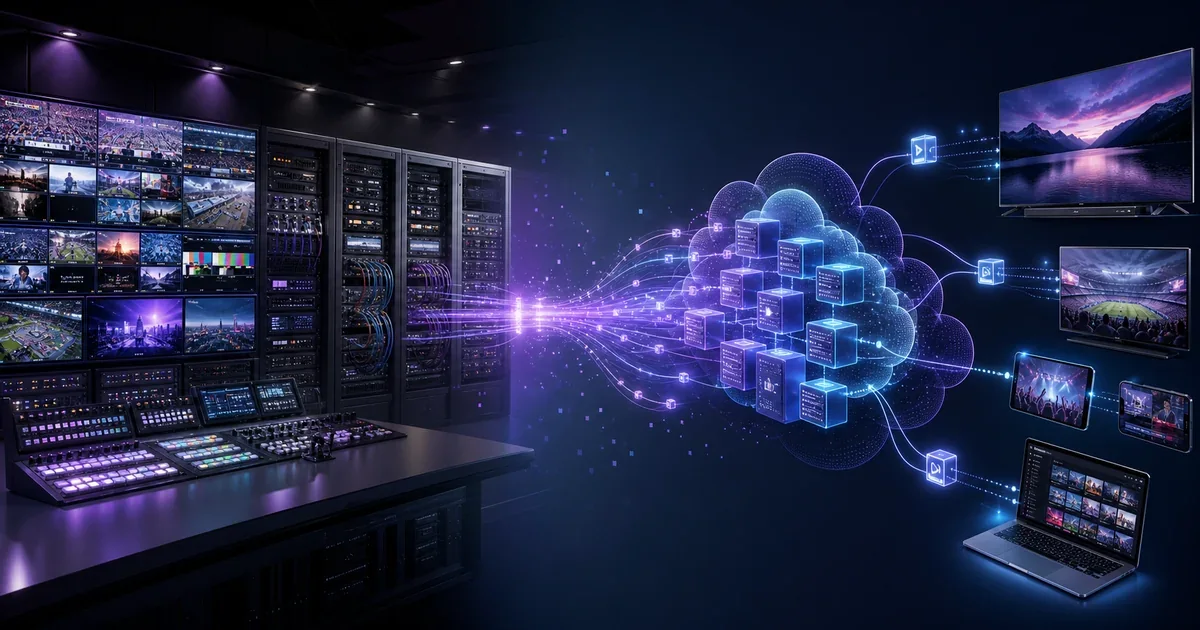
On-premises master control made particular sense when viewers received over-the-air or cable feeds and the video path could remain inside a broadcaster's facility until transmission. Internet-delivered linear television changes that boundary. CDNs must absorb audience peaks, SSAI makes decisions per session, and just-in-time packaging creates device-appropriate HLS or DASH outputs. Even if master control stays on premises, a material part of the channel is already running in elastic infrastructure.
Putting master control in the cloud does not place it literally beside viewers, who are served from CDN edges. It does place scheduling, playout and switching in the same IP-native operating environment as origins, packagers, ad services and cloud distribution. That can reduce backhaul and fixed handoffs between a facility and the online delivery stack, while giving distributed operations teams one place to scale and monitor the complete channel.
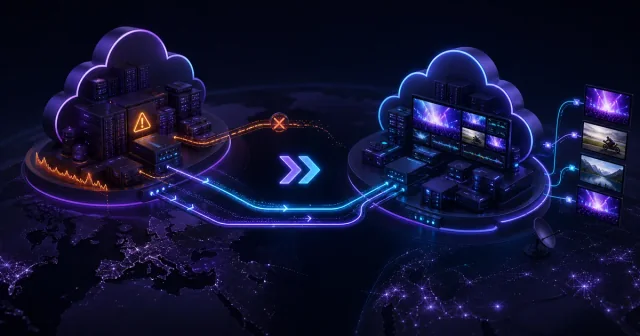
Resilience that can cross failure domains
Cloud regions and availability zones make geographic separation accessible, but redundancy is not inherited automatically. AWS MediaLive's technical guidance distinguishes pipeline redundancy from automatic input failover: dual processing pipelines protect the channel process, while separate upstream sources and network paths are still needed to protect the input (AWS MediaLive resiliency planning). The same principle applies to identity, control, storage and distribution.
The Cost Question Is More Than CAPEX vs OPEX
An on-premises comparison should include equipment, support contracts, spare units, power, cooling, rack space, connectivity, facility resilience, engineering time and the next refresh. It should also price unused capacity bought for peak demand. A cloud comparison should include always-on compute, storage transactions, data transfer, observability, premium support, software licences and the people needed to control consumption.
A heavily utilised 24/7 channel may not be cheaper in the cloud on infrastructure cost alone. Cloud economics improve when capacity varies, operations consolidate, launches become faster, or the business avoids duplicate facilities and refresh risk. Model a realistic three-to-five-year service, including migration and exit costs, rather than comparing one appliance quote with one hourly compute rate.
A Real-World Migration Example
In an AWS-published BT customer case study, BT reports migrating 213 linear channels for OTT distribution within 12 months. The case study says channel build time fell from days or weeks to hours. This is vendor-published evidence about one large migration, not proof that every broadcaster will achieve the same result, but it demonstrates where software-defined capacity and repeatable deployment can change the pace of operations.
A Hybrid Migration Is Often the Practical Answer
Many broadcasters do not need a single irreversible choice. Local production, SDI or ST 2110 routing and specialist inputs can remain at the facility while secondary channels, disaster recovery, pop-up services or OTT outputs move first. An IP gateway can bridge contribution and distribution while teams prove monitoring, security, cost controls and operating procedures.
Cloud Playout Decision Checklist
- Are channel count and output requirements stable, seasonal or growing?
- Which live inputs and control systems must remain local?
- What recovery time and recovery point objectives does each channel require?
- Can primary and backup signals, identities and distribution paths be truly independent?
- Where are operators located, and what must they control during an incident?
- What is the full three-to-five-year cost, including people, facilities, connectivity and change?
- Can the architecture be tested or migrated one channel at a time?
Conclusion: Choose the Operating Model, Not the Fashion
Cloud playout is strongest when broadcasters need elasticity, rapid channel creation, distributed operations and software-defined resilience. Traditional master control remains rational for stable, highly utilised services with valuable existing infrastructure or demanding local workflows. Hybrid architecture can preserve those strengths while introducing cloud capabilities where they produce a measurable result.
Evrideo Broadcast provides cloud-native scheduling, master control, playout, monitoring and distribution for organisations ready to operate channels as software. The right first step is to map the channel's real dependencies, service objectives and cost profile before deciding where each function should run.