
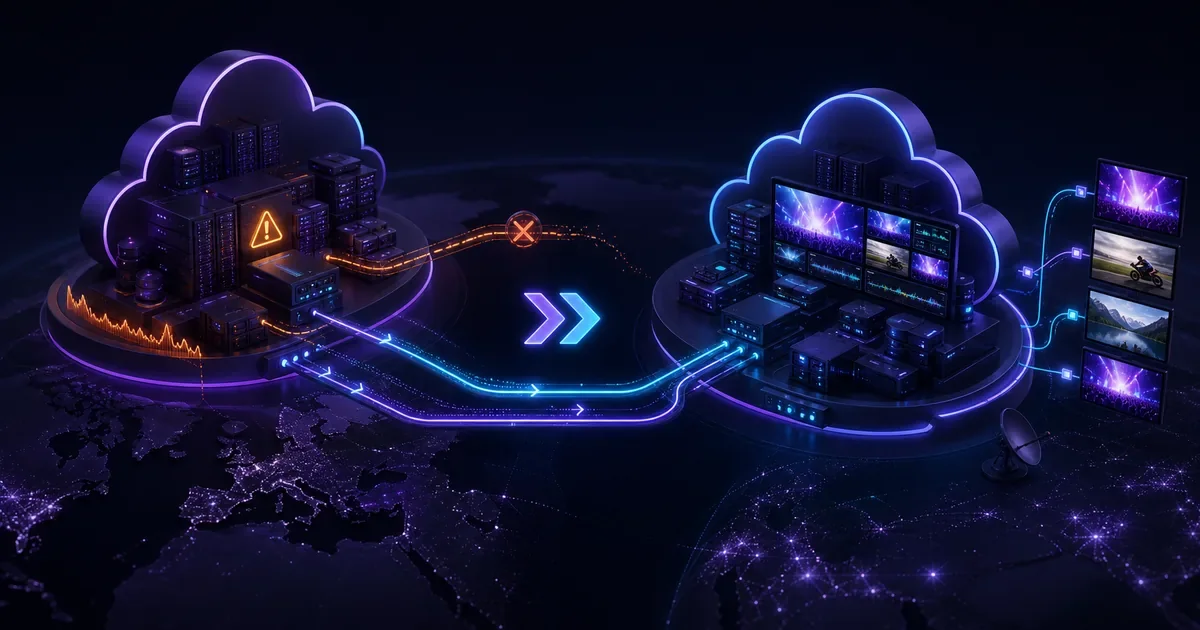
Broadcast Disaster Recovery: Designing Cloud Resilience
Broadcast disaster recovery is not a backup server waiting for the building to lose power. It is the proven ability to preserve schedules, media, live inputs, graphics, captions, ad signalling, control and distribution when an entire failure domain disappears.
That distinction matters because a channel can remain technically encoded while still being operationally unusable. The video may continue, but the automation database is stale, a live source cannot be switched, SCTE-35 markers are missing, operators cannot reach the control plane, or the recovery output follows the same carrier as the failed primary. Cloud infrastructure can make recovery faster and more testable, but only when broadcasters design the whole service for failure.
Broadcast Disaster Recovery Starts With RTO and RPO
Two measures turn a vague promise of resilience into an engineering requirement. The recovery time objective (RTO) defines how long a service may be unavailable. The recovery point objective (RPO) defines how much recent state or data may be lost. Microsoft’s current reliability guidance warns that zero RTO and zero RPO are difficult and expensive, and recommends setting objectives for each workload rather than applying one target everywhere (Microsoft reliability guidance).
A premium live channel may need recovery measured in seconds, with schedule and control state replicated almost continuously. A media archive might tolerate a longer restoration window if immutable copies exist. A compliance recorder has a different objective again: continuity and evidential integrity may matter more than immediate operator access. Treating all three as “broadcast systems” hides the business decisions that should drive the design.
High Availability Is Not Disaster Recovery
High availability handles expected component failures inside the normal production environment: a process restarts, an encoder switches, or an availability zone fails. Disaster recovery addresses broader loss, such as a regional outage, corrupted configuration, cyberattack, control-plane lockout, facility evacuation or shared network failure.
The ITU’s report on cloud programme production says that placing backup critical broadcast infrastructure in a different region or availability zone can be effective during a disaster. It also describes cloud playout as software switchers, encoders and multiplexers whose signals and fault alarms are remotely monitored (ITU-R BT.2539-1). The important word is different. Two paths in one account, region, carrier or identity system may be redundant on paper while sharing the event that takes both down.
Choose the Recovery Pattern That Matches the Channel
Active-active for channels that cannot wait
Two independent environments process the channel simultaneously. A routing or distribution layer selects the healthy output, and both paths receive synchronized schedules, media and live inputs. This offers the shortest RTO but costs more and creates a new challenge: proving that the supposedly independent paths do not share hidden dependencies.
Warm standby for a practical cost balance
A secondary environment keeps current state and essential services ready, while expensive processing capacity scales when recovery is declared. Warm standby suits many linear and FAST channels because it reduces standing cost without relying on a full rebuild during the incident. Operators must know exactly how long scaling, input rerouting, output validation and partner switching take.
Cold recovery for lower-priority services
Infrastructure definitions, configuration, media indexes and backups are retained so the service can be rebuilt. This is economical for non-urgent channels, but the measured restore time must include infrastructure provisioning, credentials, software versions, media retrieval, DNS or routing changes, and end-to-end confidence checks. A deployment template is not a recovered channel until pictures, sound, signalling and control have been validated.
A Broadcast Recovery Plan Must Protect State and Signals
Cloud recovery is often discussed as compute capacity, yet the irreplaceable parts are usually state and connectivity. Protect the current schedule, secondary events, graphics data, rights windows, captions, automation configuration, user roles, audit history and destination parameters. Keep recoverable infrastructure definitions and known-good software artifacts outside the production failure boundary.
The signal paths need equal scrutiny. Primary and backup contribution feeds should use genuinely diverse encoders, internet providers and routes. Recovery outputs need pre-agreed endpoints and credentials. Monitoring must run outside the service it observes, otherwise the dashboard can disappear with the channel. The EBU’s Resilient Distribution report deliberately avoids prescribing one transport and instead asks broadcasters to evaluate resilience, SLA and business continuity according to their own circumstances (EBU Technical Report 094).
Cyber Recovery Changes the Meaning of a Backup
Replication protects against hardware failure, but it can faithfully replicate a damaging configuration or encrypted data. Cyber recovery therefore requires clean, independently controlled recovery points. CISA recommends offline, encrypted backups, regular integrity tests, golden system images and version-controlled infrastructure-as-code templates that can rapidly redeploy cloud resources (CISA StopRansomware Guide).
For broadcast operations, that means separating production identities from recovery authority, protecting keys and secrets independently, recording configuration changes, and defining how the team establishes that media and control data are trustworthy before failover. A fast recovery into a compromised environment is not resilience.
A Practical Channel Recovery Exercise
Consider a broadcaster running a national linear channel from Region A with warm standby in Region B. The exercise removes access to the primary region rather than merely stopping one encoder. The team must promote the replicated schedule database, confirm media availability, reconnect two independently routed SRT inputs, start playout and graphics, validate captions and SCTE-35, switch distribution partners, and verify the output using monitoring hosted elsewhere.
The clock stops only when the replacement output is correct and controllable. The review then compares actual RTO and RPO with the targets, records every manual dependency, and updates the runbook. NIST contingency-planning guidance treats testing, training, backups, recovery and reconstitution as an ongoing programme, not a document completed once (NIST SP 800-34 Rev. 1).
Conclusion: Recovery Must Be a Routine Broadcast Workflow
Broadcast disaster recovery becomes credible when the architecture separates failure domains, the business defines realistic RTO and RPO targets, state and signals are both protected, and operators rehearse the complete failover. Cloud makes independent capacity, repeatable deployment and remote operation easier to obtain; it does not remove the need for engineering judgement or testing.
Evrideo Broadcast brings scheduling, playout, switching, monitoring and distribution into a cloud-native operating model, while Evrideo’s managed services provide continuous operational oversight. What matters is whether the team can get the channel back on air, and regular recovery drills mean they already know the answer.