
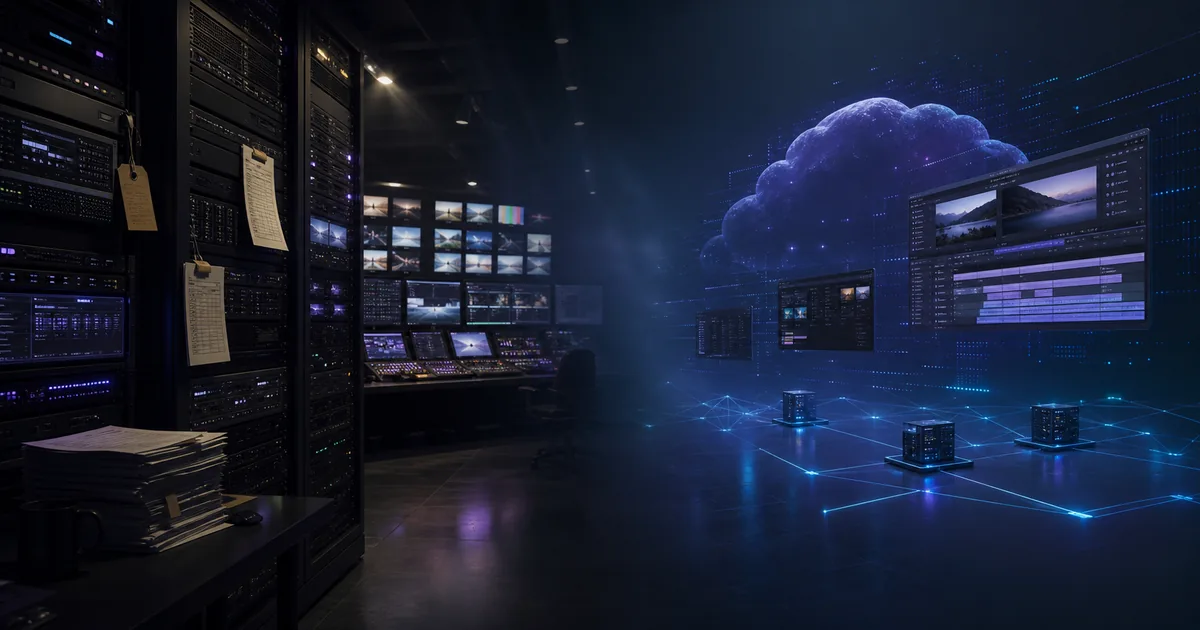
Why Traditional Broadcast Infrastructure Is Becoming Too Expensive
Traditional broadcast infrastructure is becoming too expensive not because broadcasters suddenly became inefficient, but because the economics around television changed faster than the facilities built to run it. A master-control room designed around fixed hardware, satellite-centric distribution, dedicated operators and multi-year refresh cycles was a rational investment when channel line-ups were stable. In 2026, the commercial problem is different: audiences are fragmented, advertisers expect measurable outcomes, and content owners need to test new linear, OTT and FAST services without committing millions before the first viewer arrives.
Traditional Broadcast Infrastructure Costs Are Moving in the Wrong Direction
The first pressure is capital. On-premise playout requires servers, automation, routing, monitoring, graphics, storage, backup chains, networking, power, cooling, rack space and disaster recovery. Each layer has a lifecycle. When one layer ages out, the broadcaster rarely replaces only one box; codecs, redundancy models, compliance workflows and support contracts tend to move together. That turns "keeping the channel on air" into a periodic capital event.
The second pressure is utilisation. Hardware is bought for peak requirements, not average requirements. A broadcaster that needs to handle a sports final, a seasonal pop-up channel or a UHD simulcast must provision for that peak even if most days are quieter. In a fixed facility, idle capacity still consumes depreciation, floor space, support attention and energy. Cloud-native playout changes the shape of the bill: capacity can follow the channel plan instead of being stranded in racks between events.
Viewing Has Moved Faster Than Infrastructure
The business case for heavy fixed infrastructure is weaker when viewing itself is no longer fixed. Nielsen reported that in May 2025 streaming reached 44.8% of total U.S. TV usage, ahead of broadcast and cable combined at 44.2% (TVTechnology summary of Nielsen's Gauge data). Comscore's 2025 State of Streaming research also found that viewing hours across major free ad-supported streaming services rose 43% year over year in August 2025 (TVTechnology summary of Comscore).
Those shifts matter commercially. They push broadcasters toward more endpoints, more device profiles, more ad models and more frequent channel experiments. A fixed master-control stack can still run a channel beautifully, but it is a poor financial match for a market that rewards launching, measuring, iterating and retiring services quickly.
Advertisers Now Expect Digital-Style Outcomes
The advertising market is also pulling infrastructure in a new direction. IAB's 2025 Digital Video Ad Spend & Strategy reporting highlighted buyers' growing expectations for CTV, biddable inventory, interactive experiences and real-time data around live streaming (TVTechnology summary of IAB's 2025 report). That creates operational consequences: ad markers must be accurate, SSAI workflows must be consistent, reporting must be integrated, and channels must be packaged for both traditional and digital distribution.
Legacy infrastructure can support those workflows, but often through bolt-ons: another appliance, another integration, another monitoring dashboard, another specialist support path. The cost is not just the purchase order. It is the organisational drag that comes from running a broadcast plant and a streaming plant as parallel worlds.
Supply Chain Risk Is Back on the Balance Sheet
The hardware question is not only about depreciation. It is also about availability. During COVID, broadcasters and systems integrators saw how quickly server, storage, GPU and specialist broadcast hardware lead times could move from weeks to months. A planned refresh became a procurement problem. A channel launch could be delayed not because the business case was weak, but because the physical components were unavailable or unaffordable at the moment they were needed.
A version of that pressure is appearing again. The AI boom has pulled enormous demand toward memory, GPUs, networking components and the specialised chips used in accelerated compute. Proprietary ASIC and FPGA-based broadcast appliances are not isolated from that supply chain; they still depend on advanced semiconductors, board capacity, memory allocation and vendor-specific manufacturing slots. When the market tightens, smaller buyers can find themselves waiting behind hyperscalers, AI infrastructure projects and larger enterprise commitments.
Cloud providers are not immune to supply constraints. They also need memory, GPUs, CPUs, networking and data-centre capacity. The difference is purchasing power and planning leverage. A broadcaster that needs to encode a new stream should not have to wait months for hardware to arrive, rack it, test it and integrate it. In a cloud-native model, the infrastructure provider absorbs more of that capacity-planning burden, so the broadcaster can make a channel decision when the commercial opportunity appears rather than when a procurement cycle finally clears.
The Hidden OPEX Problem: People, Maintenance and Risk
Broadcast infrastructure cost is often discussed as CAPEX, but the larger issue is OPEX. Every on-premise chain needs patching, vendor coordination, spares, access control, failover testing, compliance monitoring, overnight support and incident response. Skilled broadcast engineers are expensive because their judgement is valuable, and tying that judgement to routine hardware maintenance is a poor use of scarce expertise.
Risk also becomes an operating cost. A five-year-old playout server can work perfectly until it does not. A satellite contract can be predictable until an audience or rights package moves OTT-first. A disaster recovery site can look prudent until maintaining duplicate infrastructure absorbs budget that could have launched new services. The financial question is no longer "Is the facility paid for?" It is "What opportunities are being blocked because fixed infrastructure must be protected?"
A Concrete Example: Cloud-Ready Playout Replaces Refresh-Cycle Thinking
Recent broadcast upgrades show the direction of travel. In 2025, Sky Network Television in New Zealand selected Grass Valley's AMPP and Playout X to modernise playout across 10 HD channels, replacing an older Morpheus ICE environment and adding UHD support. The project was described as a flexible, cloud-ready environment supporting on-premise, hybrid and cloud-burst operations (TVTechnology coverage).
The important lesson is not that every broadcaster should choose the same vendor or architecture. It is that the refresh conversation has changed. Modernisation is no longer just "replace the box with a newer box." It is about gaining elasticity, API integration, event-driven scaling and faster channel expansion. Those are commercial capabilities, not merely engineering preferences.
What Cloud Playout Changes Financially
Cloud playout does not make cost management disappear. Poorly designed cloud workflows can waste money too. The difference is controllability. Teams can align resources with active channels, spin up temporary services, use automation for repetitive continuity tasks, centralise monitoring, and avoid buying peak hardware years in advance.
For content owners, that changes the launch equation. A library that could not justify a permanent linear channel may justify a FAST channel. A tournament that could not support full-time infrastructure may justify a pop-up live service. A broadcaster that wants to test a regional feed can do it without waiting for a hardware procurement cycle. Evrideo's role in that model is to combine scheduling, playout, live switching, ad insertion and distribution in one cloud-native workflow, so the commercial experiment does not become an integration project before it becomes a channel.
The New Business Case
The old business case for traditional broadcast infrastructure was control: own the equipment, own the process, own the resilience. That still matters. But control now has to include speed, cost flexibility and revenue optionality. If a broadcaster cannot launch a new channel, test a FAST proposition, support OTT distribution or adapt ad workflows without a major infrastructure project, the infrastructure is not merely expensive. It is constraining growth.
Traditional broadcast infrastructure is becoming too expensive because it asks media companies to fund certainty in a market defined by change. Cloud-native playout is not a magic discount; it is a different operating model. The strongest broadcasters will use it to move fixed cost into flexible capability, protect engineering time, and turn more content into more monetisable services. Learn more about how Evrideo Broadcast helps teams operate linear, OTT and FAST channels without rebuilding the broadcast plant for every new opportunity.
Related Articles

The Real Cost of Broadcast Infrastructure: A TCO Analysis
January 10, 2026 · 8 min read

DASH vs HLS: Pros, Cons and How to Choose the Right Streaming Protocol
June 28, 2026 · 14 min read

Introducing Evrideo StreamCheck: A Free SRT Diagnostic Tool for Broadcast Engineers
June 22, 2026 · 7 min read